Showing posts with label food security. Show all posts

Wednesday, September 30, 2015

Small-scale organic farming can feed the world

In our work, we've seen the incredible contributions women farmers continue to make in their communities when small farms and home gardens, and their caretakers, are uplifted and respected.  This is also something we're seeing in the news more and more each day—but it's not a new idea.  Obviously, small farmers have known this simple truth for years, and apparently, so has the United Nations.  

In a 2013 report by the UN Commission on Trade and Development (UNCTAD) titled “Trade and Environment Review 2013: Wake Up Before It’s Too Late,” which included contributions from more than 60 experts around the world, UNCTAD urges us all to make some big changes in our agricultural practices.

Image: eatdrinkbetter.com
"Even as the United States government continues to push for the use of more chemically-intensive and corporate-dominated farming methods such as GMOs and monoculture-based crops, the United Nations is once against sounding the alarm about the urgent need to return to (and develop) a more sustainable, natural and organic system."
Read the full article from TECHNOLOGYWATER here, and the Trade and Environment Review 2013 report here.

Thursday, July 17, 2014

WEA Partnership with GREEN Foundation Supports Women Farmers in Karnataka

In India, climate change, the steady degradation of natural resources, as well as political and social unrest and inequity, has severely affected the lives of millions of rural poor—a majority of which are women—who depend on natural resources for their livelihoods. These barriers help to make women and girls more vulnerable to societal and health dangers, and reinforces patriarchal practices that deny them access to arenas where decisions affecting them are made.

That's why WEA was thrilled to partner with GREEN Foundation last year to recognize the knowledge and expertise of women farmers to promote food security and build community resiliency. Through this partnership and GREEN Foundations amazing efforts on the ground, women farmers in Karnataka were mentored, trained and supported as they shared and built their skills in sustainable agriculture, seed saving, income generation, community organizing, and leadership around climate adaptation.


Monday, December 23, 2013

Recognizing Women's Leadership to Mitigate Conflict & Climate Change

Blog post by: Rucha Chitnis, Director of Grantmaking (@ruchachitnis)

Manipur, a state in India bordering Burma, is part of the "Seven Sisters" -- seven contiguous states in Northeastern India, known for their rich ethnic diversity, bountiful natural resources, as well as political conflict and turmoil.  For over 50 years now, Manipur has been bound by the controversial Armed Forces Special Powers Act, which grants extraordinary powers to the Indian armed forces to suppress separatist insurgencies in the region.  This act has been fiercely criticized by human rights groups for its abuse by the Indian Army through arbitrary killings, torture, enforced disappearances and violence perpetrated against women.


Northeastern states, like Manipur, are also ecologically fragile lands, and are part of the Eastern Himalayan tracts that are considered a major biodiversity hotspot.  In recent times, big dams, mining and oil exploration activities and rapid forest degradation have deeply concerned environmental advocates, especially as the impacts of climate change are worsening economic and food security in the region.


Women play a crucial role in all socio-economic aspects Manipur and are key food producers.
Earlier this year, I traveled to Manipur to learn about the emerging priorities and strategies of women's groups to promote sustainable development and livelihoods in the midst of political tensions, militarism and ecological vulnerabilities. Our grantee partners in Manipur, Rural Women Upliftment Society (RWUS) and Weaker Sections Development Council, (WSDC) are using holistic multi-pronged approaches to promote food security, advocate for peace and security, and raise awareness on climate change among vulnerable Indigenous hill tribes.

A women's group in Chandel district that is growing and processing organic turmeric as a collective

Ignored by History: Recognizing Manipuri Women's Role in Social Movements

Shangnaidar Shangdar, leader of WSDC, is passionate about highlighting the role of women in Manipur to forge long-term movements to bring peace and security in the region. Historically women in Manipur have also led brave social movements, including fighting British imperialism. Known as Nupi lan, or women’s war, women in Manipur led a successful brave agitation in 1939 protesting exploitative British free trade laws that precipitously raised the price of rice by increasing exports, and adversely affected local communities and small traders through food shortages. Sadly, these crucial resistances by Manipuri women are largely invisible and unknown in mainstream India's historical chronicles.

During my visit, Shangnaidar took me to Ima Keithel, also known as Mother's Market, which is a sprawling market in the capital city of Imphal, where all stalls are run by women. Mother's Market stands out as a proud, unique heritage of Manipur, which speaks powerfully to the crucial role women play in socio-eonomic realms here.

These women are promoting inter-tribal peace building efforts & are training women affected
by gun violence and HIV/AIDS on weaving and other livelihood generation activities


WSDC raises awareness among women widowed by gun violence and HIV/AIDS on their rights and entitlements from the state, including widow pension and food security provisions. They are also training communities on organic farming practices, raising awareness on the rights of small farmers, and are supplementing women’s income through diversifying their livelihoods by soap making, weaving and artisanal bamboo products.

Both of our grantee partners recognize that empowering women, and promoting their political, social and cultural rights, is crucial for peace building and strengthening civil society and ushering sustainable development.  WSDC and RWUS also organize trainings and educational activities to promote women’s role in governance and in conflict resolution.

Recently RWUS conducted several workshops to raise awareness on climate change among women in the hilly tribal areas of Churachandpur, the largest district of the Manipur.

“Being largely an agrarian economy, climate change is affecting the economy of the state over time. Unnoticed by the policy makers, one of the major victims of climate change have been the marginalized women of the society, who have always suffered for being financially weak and also for lacking the power of decision making in the society.”  RWUS further notes that climate change is affecting water availability in the region and is making agriculture increasingly harder for small farmers.
A small grant from WEA is enabling RWUS to organize women in 15 vulnerable tribal villages affected by climate change.  With WEA's support, RWUS is raising awareness on the crucial need to protect Manipur’s forest biodiversity and other natural resources, and the key role women can play in protecting their environment and promoting sustainable livelihoods.

“The impact of climate change has already forced many to abandon their existing professions and search for alternatives. Many women particularly youth are forced to move out of home to seek employment elsewhere because agriculture has become unsustainable,” notes the RWUS team.
In the near future, RWUS plans to organize workshops for women on dams and mining and how they impact Indigenous livelihoods, culture and way of being, as well as continue their assessment on the impact of climate change on women and promote women’s role as environmental advocates.

RWUS shares how one of the participants of the climate change training called Sangpui, a mother of three, began taking personal responsibility to protect the environment. Sangpui went on to plant over 1000 saplings and is slowly recognizing how forest degradation affects her community. “Each time I plant a tree, I realize I am contributing to sustain the livelihood of forest dependents, like me,” she says.


Wednesday, September 4, 2013

Making the Invisible Visible: Valuing women’s work and challenging gender bias in agriculture and resource rights


Blog by Rucha Chitnis,WEA's South Asia Program Director

Yashoda is slowly stepping into a leadership role in her community
“A woman is not recognized for her work,” declares Yashoda, a woman farmer in the drought-prone area of Challekere in Karnataka, India.  Yashoda is among many women farmers, who believe that they are not valued for the multiple roles they juggle as farmers, resource managers, caregivers and homemakers.

“Sometimes I wonder why I work so hard when the land is not on my name,” Yashoda continues.  We are on a small family farm, meeting women farmers, who share how gender discrimination defines how women’s immense contribution to agriculture is often overlooked and undermined. Gender inequalities also erode women's ability to access and manage land and other productive resources and pose as a significant barrier to promoting their economic security and self reliance. 

According to the United Nations Populations Fund, women work longer hours than men, in almost every country, but are usually paid less and are more likely to live in poverty. This is the same case in agriculture as well, where gendered roles imply that women perform almost all aspects of farming and post harvest activities but receive little recognition for their efforts. In India, as in many parts of the Global South, women farmers are key food producers and biodiversity managers, yet their labor remains invisible and unrecognized in their own communities and in broader policymaking.

Women farmers are learning about the importance of seed saving
of native crops  during drought conditions
A series of grants from Women’s Earth Alliance is enabling our partner, the GREEN Foundation (GREEN), to address this gender bias in agriculture and mentor women farmers, like Yashoda, as community leaders, who in turn will act as mentors and resource people to other women in their communities in sustainable agriculture and promote rights of women as farmers.

Over the past 18 months, the GREEN team has worked hard to offer a holistic capacity building program for women farmers; these include peer to peer exchanges with farmers who are pioneering sustainable agriculture practices and are diversifying their livelihoods through poultry management and growing fruit trees with food crops. Challekere is a drought-prone area and women, as water primary water collectors, bear a disproportionate brunt of this scarcity. Recognizing the impact of these gendered roles on women, GREEN has also trained them on making "wicking" beds, a water efficient and space saving method for vegetable cultivation and on other dry land management practices.

“We aim to break through mental, social and cultural barriers that define women’s lives, in order that they may become true leaders of their communities. An important aspect of our approach, therefore, involves initiating discussion platforms that create an inclusive, safe atmosphere for women to express their struggles and gain the confidence needed to become strong advocates for their own cause,” notes Veena Hassan, a gender expert and the former project director at GREEN.

Rural women are often sidelined in political leadership and decision-making, and GREEN staff have oriented women farmers on Panchayat (local self governing units) schemes and services and have  mentored women to embrace their leadership in their respective villages so that they can demand their rightful entitlements by forming peer pressure groups if they were denied any services due to corruption or exploitation of poor farmers.

Veena believes that self-sustenance of women at, both, individual and community level is crucial and that promoting sustainable agriculture practices with a strong framework of human rights is an approach that has great potential for creating a peaceful, ecologically balanced and just society. 

“I felt like I was in a well and now I am surfacing and swimming in a bigger world,” reflects Yashoda on the impact of her participation in GREEN's women’s leadership program. 

Veena Hassan, far left, believes that women need to embrace their
leadership at, both, the individual and community level

Monday, June 24, 2013

A Ballad of Resistance: An evening with feminist film-maker, Leena Manimekalai

By Lauren Bellenie, WEA General Intern

Dayamani Barla was jailed last year to silence her anti-displacement activism.
On June 18th, friends of WEA, old and new, trickled into the David Brower Center to meet a special guest speaker, Indian social justice film-maker, poet and actress, Leena Manimekalai.  Rucha Chitnis, WEA's South Asia Program Director, welcomed everyone to the event and shared how indigenous women were on the frontlines of global resistance against landgrabs that threatened their ancestral homelands, and how films, such as Leena's "Ballad of Resistance", are an important vehicle to highlight the crucial role women play in social movements and defending human rights.

Guest speaker, Preeti Mangala Sekar, ED of Narika, read a poem written by Leena called "Penalty." The poem framed the public response to Leena's poetry, including demands from some right wing voices, who shunned it as "pornographic" writing. The poem's content highlighted the feelings and situations that arise when the only path to follow is one that is honest, yet perceived by some as inflammatory because it expresses and asserts female sexuality and power. Leena relates to this through her own unconventional life path and through the stories of human rights activists, especially women, that she documents in her films.

Leena sharing about her personal journey as a feminist film-maker

Leena screened "Ballad of Resistance", which follows Dayamani Barla, India's first indigenous female journalist from Jharkhand, who has centered her life on protecting ancestral lands occupied by tribal communities in her state. "Ballad of Resistance" offers a breath-taking view into the longterm social action against the external pressures of development facing indigenous communities in India.  The film shows how Dayamani works tirelessly at the grassroots, documenting the struggle through her journalism and efforts to organize tribal communities to stand strong against corporate landgrabs for mining and other industrial development projects.

Dayamani explains in the film that the Munda tribe has been resilient to many attempted impositions over the years. She notes that this area represented resistance against British colonizers, long before the time of Gandhi. Though the fights have not always been easy, their persistence has afforded them their land rights on multiple occasions. Today, women are on the frontlines of these movements against land grabs from powerful forces. One moving scene in the film showed women from Nagri communities tearing down walls of government-santioned construction sites to make way for business and law schools, despite police presence. The women featured in the film echoed the sentiment, "We will give our lives but not our land."  Dayamani stands for the dignity, rights and identity of her community and the ancestry that constitutes the foundation for their relationship with "Mother Nature".

Anu Mandavilli introduces Leena
Throughout the evening, the audience gained fascinating insights into Leena's own life as a feminist artist and activist. During the question and answer portion, Leena shared how she began making films to document lives of people, who are left out of mainstream media and development processes. She explained that she would go to communities and document their story of oppression, and then the oppressors of that group would also want her to document their story as well.

Leena's films are creative and effective means to highlight human rights violations, as well as the agency of local communities to demand justice and dignity. When Dayamani was arrested in 2012 for two and a half months, supporters used Leena's film as a means to raise awareness to free her.  Attendees were so engaged in the discussion with Leena that it continued well past the scheduled finish time.

Leena closed with a statement about our role in these issues as international allies. She encouraged our role as funders, given the sparse monetary sources available for NGOs and social movements in India and profoundly stated that "Indian resistance is at a challenging point, but we can give them hope and solidarity that they are not alone."

Special thanks to activist, Anu Mandavilli and Friends of South Asia for partnering with WEA to host this gathering.

Tuesday, March 5, 2013

Food - Not Just a Source of Profit But A Source Of Nutrition & Sustenance

Dr. Vanaja Ramprasad, founder of WEA's partner in India, the GREEN Foundation, shares what the global community can learn from women farmers in India.


Why Food sovereignty? In renaming the concept, we have moved away from the mainstream discourse using familiar terms such as food security, right to food or entitlement to food. No doubt that this is a complicated issue since food production and availability play a critical role in a country’s progress.

The multidimensional nature of food production spans across several issues starting with appropriate use of natural resources such that it does not erode into needs of the future generation. Today’s technological developments have brought in a new dimension to the production, distribution and consumption of food and that new dimension is the global politics of control over food in all its spheres.

Yet, at the same time there is a growing resistance against control over food as a source of nourishment, and not poison, as a source of peace and not conflict, as a source of health and not as disease, as a source of prosperity and not poverty, as a source of nurture and not destruction and decimation. The resistance is to free the notion of food as a weapon and from the shackles of globalised control.


Green Foundation – which has been working on vital issues such as seed conservation, also works on viable alternatives that have emerged from its intensive field-based work with small and marginal farmers in rain-fed areas of India. In this effort women have played a major role in self provisioning food for their families and their communities.

The crisis that today’s farming community is facing is complicated by links with agro-chemical companies, seed companies, veterinary drugs, banks, food processors, retailers, packers and other stake-holders in the food production and distribution chain. Each link in the chain is being controlled more and more by giant corporations.India in the last three to four decades has focused on chemical intensive farming and reached national level self sufficiency, but today we are importing wheat which is the staple food of millions in this country. We have farmers committing suicide.


Women have played a major role in changing the mindset of the Green Revolution era, which did not look at the regional variations. Women all over have shown that food supply is not a source of profit but a source of nutrition and sustenance. There have been efforts to empower women to remodel the system to bring together the water, soil and the flora and fauna to perceive it as the food we eat. Women have demonstrated that the most important lesson we learn is the circular loops of fertility, seeds and resilience of communities in the food web and have shown that food production is also about biology and not just economics.

Monday, August 27, 2012

Dr. Seema Tripathi: Leading Change at the Grassroots


Dr. Seema Tripathi at a rally in U.P., India
Women’s Earth Alliance (WEA) is thrilled to welcome Dr. Seema Tripathi to the Bay Area in early September! Dr. Seema is one of the leaders of WEA’s partner in India, Gorakhpur Environmental Action Group (GEAG), an organization that promotes the rights and just livelihoods of small and landless farmers in the state of Uttar Pradesh. 

Dr. Seema has over 16 years of experience working in the development sector, coordinating various activities related to training, resource and communication materials on issues like gender and development, disaster management, climate change resilience and participatory development. She has rich experience organizing and working at the grassroots on community mobilization, leadership development and communication methodologies and has consulted with groups like UNICEF, NABARB and projects of the Indian government. Dr. Seema is a doctorate in Educational Psychology and is passionate about music and traveling.

GEAG is a grassroots organization working with small and landless women farmers through a people-centered approach focusing on their participation and empowerment for sustainable development.  In 2011, WEA was honored to partner with GEAG to fund the innovative Women, Food Security and Climate Change Training Program. Dr. Seema played a crucial role organizing this yearlong training program and developed a training manual for rural women, who are also grassroots community trainers and activists, and play a crucial role in building the resilience of vulnerable farmers in the face of climate change.

Special Event Honoring Dr. Seema! 
Please join us for Seeds of Resilience: Women Protecting their Right to Land and Food on September 12th at 6:30 PM at the David Brower Center in downtown Berkeley. Dr. Seema will share personal stories, struggles and victories of women farmers in the state of Uttar Pradesh, who are using advocacy campaigns and ecological farming as a key strategy to promote their economic and food security. Buy tickets here! 


Monday, July 2, 2012

Seeds of Hope

"Seed is sacred...The desire to save seeds comes form an ethical urge to defend life's evolution." Dr. Vandana Shiva


Women farmers are the custodians of seeds around the world.

Seed exchanges among small farmers are a time memorial tradition that has led to the immense biodiversity of indigenous seeds around the world. Globally, it is mostly women farmers who are the seed savers, who possess an immense of body of knowledge to save and conserve seeds of vital food crops.

This April, Women's Earth Alliance friends, Astrid Lindo and Matthew Hoffman, founders of the Living Seed Company, donated heirloom, open pollinated seeds from their collections to share with a group of very special women farmers and community activists in India. These women were participants of the North India Women, Food Security and Climate Change Training Program that was designed and coordinated by WEA's partner, Gorakhpur Environmental Action Group.

Living Seed Company donated their collection of heirloom seeds as a symbolic gesture to stand in solidarity with the efforts of these brave women in India, who are reviving seed saving practices, farming ecologically and are building the resilience of other women in their communities, who are impacted by climate change.  Thank you Astrid and Matthew for your solidarity and for your untiring efforts to secure healthy communities by promoting the life-affirming practice of seed saving.

Seeds are a glowing example of a renewable resource.


Wednesday, May 16, 2012

GWWI Women and Water on Wednesdays: Solar CooKit - Using the Sun to Clean Water


One of the cheapest and greenest ways to clean water is to harness the heat of the sun! As Mama Solar, GWWI Solar CooKit Trainer says, 'the sun is free and we here in Africa have plenty of it!'   The sun's heat is used to pasteurize water which has the same effects as boiling, but is much cheaper and is less damaging to the environment. Boiling is one of the easiest and most widely practiced water treatments promoted around the globe, but is prohibitive in developing countries for several reasons. 1) fuel or coal is costly for families making less than a $1 a day 2) wood collection contributes to deforestation 3) burning fuel, coal or wood creates air pollution.

Carrying Wood

The process of boiling requires the water to heat to 100 Celsius. Once it reaches this high temperature, it kills disease-causing germs. Pasteurization, however, requires the water only to be heated to 60 Celsius, but at a longer sustained heat. This can be achieved by putting contaminated clear water in a covered black pot (which can be painted with simple chalkboard paint) to attract heat, enclosed in a large clear plastic bag to contain the heat, and placed inside a Solar CooKit to intensify the heat.

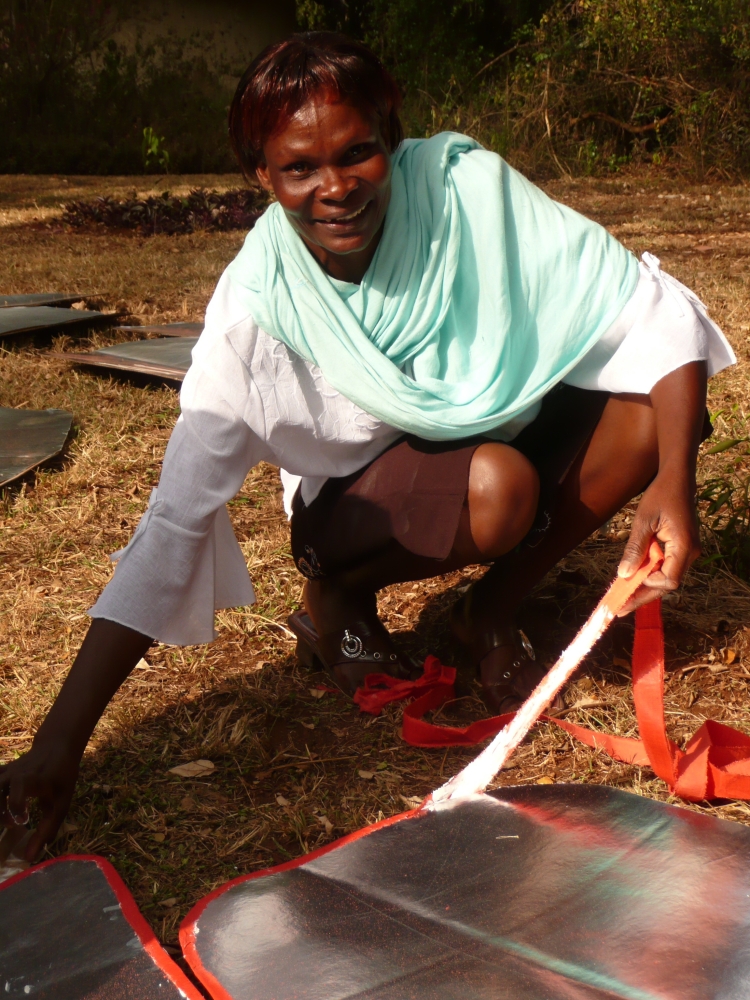
Solar CooKit with bag

The Global Women's Water Initiative introduces the Solar CooKit as one of the core technologies women learn at our Women and Water Trainings. On Day 1, women make their own Solar CooKit! Made simply with recycled cardboard boxes, reflective material (aluminum foil, the inside of juice boxes etc), cloth for lining and reinforcing the edges, and glue. In just a few short hours the women have their first technology completed and ready to use!

The finished Solar CooKits!

During the rest of the Training week, they set the CooKits up in the morning if it's a sunny day to clean their water, share recipes and cook delicious food. They leave them to sit in the sun while they spend the rest of the day in training sessions and building other technologies. When they return after a few to several hours (depending on the strength of the sun that day) their water is clean and their food is cooked!  

Food made with the CooKits

There are so many reasons to love the Solar CooKits. All the materials to make the CooKit are available locally.  Women have less dependence on coal and fuel and reduction in deforestation. Once they have the technology, cooking is free – on sunny days of course! And most important, women are freed up to do other things while they are cooking and cleaning their water. WIN for the women, WIN for the environment, WIN for family health!

You can make one too! Download the instructions and recipes here from the Solar Cookers International website. 
Like Global Women's Water on Facebook
Follow GWWI on Twitter
Follow Gemma, GWWI Director and HuffPost Blogger on Twitter

Tuesday, May 8, 2012

Climate Change Resilience Begins With Women

Blog post by Rucha Chitnis, WEA's South Asia Program Director
Twitter: @ruchachitnis

Women farmers, like Manju, play a crucial role in building the resilience
of their communities in the face of climate change

Manju Devi is a farmer, a single mother of three and a dedicated field worker with a local grassroots organization called Nav Jagriti in Bihar, one of the poorest states in India. Manju is on a mission to build the self-reliance of women in her community who are affected by poverty, food insecurity and climate change. Women farmers in her community are particularly affected by floods and prolonged waterlogging issues.

Manju was one of the participants of the Women, Food Security and Climate Change Training program that was designed and coordinated by Women’s Earth Alliance’s partner, Gorakhpur Environmental Action Group (GEAG), a grassroots organization working with small and landless women farmers through a people-centered approach focusing on their participation and empowerment for sustainable development. GEAG's efforts also target poverty and hunger reduction by connecting women farmers with sustainable agricultural training, advocacy and networking support.

The goal of this training was to facilitate a regional exchange between women farmers and rural NGO workers from four flood-affected states to share their personal experiences with climate change and its impact on their health, livelihoods and food security. The training equipped women with information about sustainable agricultural practices, such as mixed farming--growing diverse food crops on small farms and making natural pesticides and fertilizers using farm inputs.  Participants also learned about local and regional campaigns to advance women’s rights as farmers. Manju was particularly inspired meeting women from a community in Sahranpur, who were successful in winning back their forest rights access from a corrupt contractor who had exploited them for years. The women shared with, much pride, how they finally won their rights through a long sustained joint solidarity struggle.

Manju set up an organic kitchen garden as a
demonstration site for other women farmers

Manju was clearly inspired and invigorated by the training, and she returned to her community with a plan to make a difference. First, she set up her own organic kitchen garden as a demonstration site to show women farmers how they could grow a variety of vegetables right at home even if their farms were flooded. She went on to organize 11 women’s groups, training 144 farmers on seed-saving practices and growing a variety of vegetables and grains using mixed farming techniques. Finally, she educated women on their rights as farmers and shared information on beneficial government programs that women could access to improve their economic and food security. 

"My vision is that women in my community stand on their own feet and embrace organic farming practices.  I am leading by example to show how this can be achieved," she proudly beamed. Women farmers, like Manju, clearly demonstrate how they play a crucial role in building the leadership capacities of other vulnerable women in their communities who are acutely affected by climate challenges, such as floods and droughts.  As cultural and natural resource stewards of their communities, they are positioned to make a difference by using their traditional ecological knowledge systems of farming, seed saving of robust indigenous crops like millets, which require little to no water for irrigation, and by engaging actively in the political and civic affairs of their communities.

Farmers like Manju recognize that one sure way of increasing the resilience of rural communities in the face of climate change is to end the inequalities and discrimination that rural women face so that they can access critical information, useful agriculture extension training services and increase their participation in disaster management programs.  


This farmer started her own organic kitchen
garden after being trained by Manju


Another woman farmer has a steady supply of vegetables
after starting an organic kitchen garden at home

Thursday, July 7, 2011

Seeds and Their Keepers are Key to Preserving India’s Food Diversity

In India, where food security is threatened by growing climate unpredictability and industrial agriculture, women farmers are leading the way to safeguard the biodiversity of indigenous crops. 

Want to learn more? Check out this blog post written by India Program Director Rucha Chitnis on Earth Island Journals’ blog, EnvironmentaList!


Photo by Melinda Kramer

Friday, April 22, 2011

Women in the Center of Crop Diversity & Food Security


Women farmers displaying indigenous seeds that they save at a community seed bank in Karnataka.

Blog entry by Rucha Chitnis, India Program Director, who is traveling in Southern India to research women farmers’ green traditional knowledge systems for farming, seed saving and managing their natural resources.

Let’s start from the very beginning.  And some might say that it all began with the seeds.

Seed, a symbol of fertility and perpetuity, of culture and sustenance in India, is also becoming a symbol of self-reliance and a key resource to preserve the biodiversity of indigenous crops on small farms across the country.

In Southern India, GREEN Foundation, a community-based organization that works with small and marginalized farmers, including tribals and Dalits, in semi-arid regions of Karnataka, has immersed itself in this challenge of promoting the conservation of indigenous seeds among farmers since 1996.

During my visit to the Foundation, I learn that women farmers are in the center of their seed conservation efforts due to their gendered roles as the primary seedkeepers in India.  The Foundation began its work with five women farmers and a handful of indigenous seeds. “When we began talking to the farmers, we realized that traditional varieties of seeds had almost disappeared. Without seeds what we were attempting to do would be a non-starter,” notes Dr. Vanaja Ramprasad, founder and a seed conservationist.

The Foundation believes that women farmers also hold the key to preserving the biodiversity of the crops and their knowledge systems of seed saving and mixed and natural farming are vast, which need to be documented and promoted.  Dr. Vanaja shares an example of an elderly woman farmer, who identified nearly 80 varieties of greens in her field, as well as their uses for medicinal and nutrition needs. “Her knowledge was phenomenal,” she says. “When it comes to food security, women play a key role in identifying food that is available. In lean seasons, they trek to the nearby forests, and they are able to identify roots and tubers for their food requirements and medicinal plants.” 

Dr. Vanaja Ramprasad, founder of the GREEN Foundation
-->
This intimate knowledge of women, believes Dr. Ramprasad is often undermined by the scientific community and biotechnology companies who promote agro-technologies, which might not be appropriate for rural communities, and especially for the economically disadvantaged farmers. Dr. Ramprasad shares that some of the greens on the farms, which poor farmers in India subsist on during lean periods, might be considered as weeds by some agro-companies, which are eliminated by herbicides.

The Foundation programs promote the conservation of agro-biodiversity, ecological farming practices, seed conservation and creation of community-managed seed banks.   Seed conservation has been in the center of the programmatic efforts of the Foundation. Their research and analysis showed that India’s Green Revolution in the 1960s eroded the diversity of indigenous seeds with the introduction of the high yielding varieties of seeds and pervasive use of chemical fertilizers and pesticides.  As farmers moved away from the practice of saving and exchanging seeds with their neighbors and families to buying the HYV seeds from the market, their own indigenous knowledge systems related to farming and seed saving became slowly irrelevant in the face of industrial agriculture.

 Gene bank of indigenous seeds set up by the GREEN Foundation
-->
“India is a land that had over 100,000 varieties of rice,” she says, but now only a few popular varieties are sold in urban markets. The Green Revolution also focused on intensive cultivation of rice and wheat and ignored other indigenous varieties of crops, like millets--considered to be a vital source of nutrition in rural India.  The Foundation encourages women farmers to save indigenous varieties of millets, which are ideal crops to grow in arid and semi-arid areas as some varieties are drought-resistant and require little water for irrigation, compared to rice and other cash crops. As small-scale and marginalized women farmers largely depend on the rain for their irrigation needs, millets are an important source of food security in areas where recurring droughts or dwindling and unreliable rainfall cause stress among farmers.

“In many ways, we have to rekindle the pride that the farmers have in their traditional farming systems,” says K. P Suresh, Associate Director of the Foundation. He believes that the traditional role women play in seed selection, seed conservation, and seed treatment to prevent the crop from developing unhealthy, are critical and need to be documented and promoted.  Seeds also symbolize the cultural heritage of communities across India, and they are an integral part of many rituals, ceremonies and festivals.  And seed conservationists, like Dr. Ramprasad, affirm that the practice of seed saving has been a cornerstone of farming traditions that made agriculture, itself, a way of life.