Showing posts with label India. Show all posts

Tuesday, November 17, 2015

Why were the elephants so angry?

By: Katie Douglas, WEA intern

In Ulhara, a village in the city of Hazaribagh in Jharkhand, India, a group of women gathered for a cluster meeting and sat in thoughtful conversation on a rising issue: Why were the elephants of the forest so angry?

The women questioned what had driven fourteen elephants to wreak havoc and destruction in the nearby villages where many of the women were from, leaving one man dead and destroying numerous food grains, houses and crops. The women began to share how mining projects were destroying their homes and natural resources, and causing them great mental and emotional strain. They likened this to the experience of the elephants, who were losing their homes and corridors to mining and infrastructure development.

Ultimately, the women decided that they were not angry at the elephants. Instead, they understood the animal's anger and vulnerability as their own.

The natural habitat and corridors of elephants are being lost to mining and development, and they are venturing into villages where they can cause damage to both property and life.  Photo: CASS

Since 2013, WEA has partnered with Chotanagpur Adivasi Seva Samiti (CASS) to develop a community development training for adivasi (indigenous) women of the Santhal tribe in eastern India. Large-scale open-cast coal mining and infrastructure development has resulted in the destruction of land, forest, and rivers. Not only are these resources the primary means of food and fuel that the Santhal women rely on for sustaining their families and communities, but these resources also contribute medicine, peace, and spiritual sustenance. With the loss of their lands and rivers, the women have become increasingly dependent upon men and outside markets, which makes this not only an issue of environmental exploitation, but also indigenous rights and gender injustice.

In the face of environmental destruction and oppressive gender structures, these trainings provide women with different methods of support, all with the aim of helping them to exercise their rights, practice their culture, and enhance their natural resources for a future they can manage. This is facilitated through cluster groups, trainings, weekly meet-ups for female leaders, and by enrolling local girls in school. Cluster groups, like the one that met in Ulhara, are critical to the state of the community because they allow women to share stories and skills, collectively organize, and discuss basic human and forest rights.

Women gather in Ulhara village for a cluster meeting.  Photo: CASS

Through this training, adivasi women also share personal experiences and build bridges of commonality and support. These trainings ask the women to question what they know of gender. At one such training, Ms. Budhandi—a CASS volunteer—offered the group a song:

A group of men are sitting under the banyan tree
They have listened to the sufferings of women.
They are getting up and going.
The women beckon them
To come back and listen.

Discussion of songs and stories like these allow the women to sit back and view the situation through a lens that considers gender as a social construct, and that then encourages them to take their place as leaders in their communities.

Driven by the destruction of the environment, once-sustainable communities like those near Hazaribagh have been reduced to dependent entities that are disconnected from their environment and unable to protect the rights of adivasi women. This partnership aims to provide the training, support, and networks necessary to uplift the leadership of grassroots women in some of the most impacted adivasi communities in the area, therefore promoting healing and providing safety to human and elephant alike.
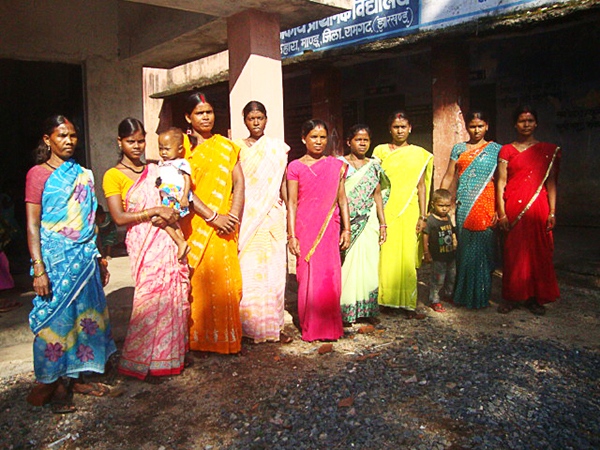
The Ulhara cluster group.  Photo: CASS

Thursday, August 28, 2014

WEA Grassroots Partner Celebrated as "Woman Warrior"

Check out this great article on grassroots women warriors--including a WEA partner!--who are protecting their lands and communities against #environmental destruction.

Suryamani Bhagat is a brave forest activist and #Indigenous leader of the Jharkhand Save the Forest Movement in #India, and has mobilized a forest watch committee to stop illegal forest destruction in her state.

WEA partnered with Jharkhand Save the Forest Movement, part of the Bindrai Institute of Research Study and Action, over the last year to support their efforts to enhance decision-making power of adivasi women, who are crucial custodians of forests and #biodiversity.


Thursday, July 17, 2014

WEA Partnership with GREEN Foundation Supports Women Farmers in Karnataka

In India, climate change, the steady degradation of natural resources, as well as political and social unrest and inequity, has severely affected the lives of millions of rural poor—a majority of which are women—who depend on natural resources for their livelihoods. These barriers help to make women and girls more vulnerable to societal and health dangers, and reinforces patriarchal practices that deny them access to arenas where decisions affecting them are made.

That's why WEA was thrilled to partner with GREEN Foundation last year to recognize the knowledge and expertise of women farmers to promote food security and build community resiliency. Through this partnership and GREEN Foundations amazing efforts on the ground, women farmers in Karnataka were mentored, trained and supported as they shared and built their skills in sustainable agriculture, seed saving, income generation, community organizing, and leadership around climate adaptation.


Monday, December 23, 2013

Recognizing Women's Leadership to Mitigate Conflict & Climate Change

Blog post by: Rucha Chitnis, Director of Grantmaking (@ruchachitnis)

Manipur, a state in India bordering Burma, is part of the "Seven Sisters" -- seven contiguous states in Northeastern India, known for their rich ethnic diversity, bountiful natural resources, as well as political conflict and turmoil.  For over 50 years now, Manipur has been bound by the controversial Armed Forces Special Powers Act, which grants extraordinary powers to the Indian armed forces to suppress separatist insurgencies in the region.  This act has been fiercely criticized by human rights groups for its abuse by the Indian Army through arbitrary killings, torture, enforced disappearances and violence perpetrated against women.


Northeastern states, like Manipur, are also ecologically fragile lands, and are part of the Eastern Himalayan tracts that are considered a major biodiversity hotspot.  In recent times, big dams, mining and oil exploration activities and rapid forest degradation have deeply concerned environmental advocates, especially as the impacts of climate change are worsening economic and food security in the region.


Women play a crucial role in all socio-economic aspects Manipur and are key food producers.
Earlier this year, I traveled to Manipur to learn about the emerging priorities and strategies of women's groups to promote sustainable development and livelihoods in the midst of political tensions, militarism and ecological vulnerabilities. Our grantee partners in Manipur, Rural Women Upliftment Society (RWUS) and Weaker Sections Development Council, (WSDC) are using holistic multi-pronged approaches to promote food security, advocate for peace and security, and raise awareness on climate change among vulnerable Indigenous hill tribes.

A women's group in Chandel district that is growing and processing organic turmeric as a collective

Ignored by History: Recognizing Manipuri Women's Role in Social Movements

Shangnaidar Shangdar, leader of WSDC, is passionate about highlighting the role of women in Manipur to forge long-term movements to bring peace and security in the region. Historically women in Manipur have also led brave social movements, including fighting British imperialism. Known as Nupi lan, or women’s war, women in Manipur led a successful brave agitation in 1939 protesting exploitative British free trade laws that precipitously raised the price of rice by increasing exports, and adversely affected local communities and small traders through food shortages. Sadly, these crucial resistances by Manipuri women are largely invisible and unknown in mainstream India's historical chronicles.

During my visit, Shangnaidar took me to Ima Keithel, also known as Mother's Market, which is a sprawling market in the capital city of Imphal, where all stalls are run by women. Mother's Market stands out as a proud, unique heritage of Manipur, which speaks powerfully to the crucial role women play in socio-eonomic realms here.

These women are promoting inter-tribal peace building efforts & are training women affected
by gun violence and HIV/AIDS on weaving and other livelihood generation activities


WSDC raises awareness among women widowed by gun violence and HIV/AIDS on their rights and entitlements from the state, including widow pension and food security provisions. They are also training communities on organic farming practices, raising awareness on the rights of small farmers, and are supplementing women’s income through diversifying their livelihoods by soap making, weaving and artisanal bamboo products.

Both of our grantee partners recognize that empowering women, and promoting their political, social and cultural rights, is crucial for peace building and strengthening civil society and ushering sustainable development.  WSDC and RWUS also organize trainings and educational activities to promote women’s role in governance and in conflict resolution.

Recently RWUS conducted several workshops to raise awareness on climate change among women in the hilly tribal areas of Churachandpur, the largest district of the Manipur.

“Being largely an agrarian economy, climate change is affecting the economy of the state over time. Unnoticed by the policy makers, one of the major victims of climate change have been the marginalized women of the society, who have always suffered for being financially weak and also for lacking the power of decision making in the society.”  RWUS further notes that climate change is affecting water availability in the region and is making agriculture increasingly harder for small farmers.
A small grant from WEA is enabling RWUS to organize women in 15 vulnerable tribal villages affected by climate change.  With WEA's support, RWUS is raising awareness on the crucial need to protect Manipur’s forest biodiversity and other natural resources, and the key role women can play in protecting their environment and promoting sustainable livelihoods.

“The impact of climate change has already forced many to abandon their existing professions and search for alternatives. Many women particularly youth are forced to move out of home to seek employment elsewhere because agriculture has become unsustainable,” notes the RWUS team.
In the near future, RWUS plans to organize workshops for women on dams and mining and how they impact Indigenous livelihoods, culture and way of being, as well as continue their assessment on the impact of climate change on women and promote women’s role as environmental advocates.

RWUS shares how one of the participants of the climate change training called Sangpui, a mother of three, began taking personal responsibility to protect the environment. Sangpui went on to plant over 1000 saplings and is slowly recognizing how forest degradation affects her community. “Each time I plant a tree, I realize I am contributing to sustain the livelihood of forest dependents, like me,” she says.


Wednesday, September 4, 2013

Making the Invisible Visible: Valuing women’s work and challenging gender bias in agriculture and resource rights


Blog by Rucha Chitnis,WEA's South Asia Program Director

Yashoda is slowly stepping into a leadership role in her community
“A woman is not recognized for her work,” declares Yashoda, a woman farmer in the drought-prone area of Challekere in Karnataka, India.  Yashoda is among many women farmers, who believe that they are not valued for the multiple roles they juggle as farmers, resource managers, caregivers and homemakers.

“Sometimes I wonder why I work so hard when the land is not on my name,” Yashoda continues.  We are on a small family farm, meeting women farmers, who share how gender discrimination defines how women’s immense contribution to agriculture is often overlooked and undermined. Gender inequalities also erode women's ability to access and manage land and other productive resources and pose as a significant barrier to promoting their economic security and self reliance. 

According to the United Nations Populations Fund, women work longer hours than men, in almost every country, but are usually paid less and are more likely to live in poverty. This is the same case in agriculture as well, where gendered roles imply that women perform almost all aspects of farming and post harvest activities but receive little recognition for their efforts. In India, as in many parts of the Global South, women farmers are key food producers and biodiversity managers, yet their labor remains invisible and unrecognized in their own communities and in broader policymaking.

Women farmers are learning about the importance of seed saving
of native crops  during drought conditions
A series of grants from Women’s Earth Alliance is enabling our partner, the GREEN Foundation (GREEN), to address this gender bias in agriculture and mentor women farmers, like Yashoda, as community leaders, who in turn will act as mentors and resource people to other women in their communities in sustainable agriculture and promote rights of women as farmers.

Over the past 18 months, the GREEN team has worked hard to offer a holistic capacity building program for women farmers; these include peer to peer exchanges with farmers who are pioneering sustainable agriculture practices and are diversifying their livelihoods through poultry management and growing fruit trees with food crops. Challekere is a drought-prone area and women, as water primary water collectors, bear a disproportionate brunt of this scarcity. Recognizing the impact of these gendered roles on women, GREEN has also trained them on making "wicking" beds, a water efficient and space saving method for vegetable cultivation and on other dry land management practices.

“We aim to break through mental, social and cultural barriers that define women’s lives, in order that they may become true leaders of their communities. An important aspect of our approach, therefore, involves initiating discussion platforms that create an inclusive, safe atmosphere for women to express their struggles and gain the confidence needed to become strong advocates for their own cause,” notes Veena Hassan, a gender expert and the former project director at GREEN.

Rural women are often sidelined in political leadership and decision-making, and GREEN staff have oriented women farmers on Panchayat (local self governing units) schemes and services and have  mentored women to embrace their leadership in their respective villages so that they can demand their rightful entitlements by forming peer pressure groups if they were denied any services due to corruption or exploitation of poor farmers.

Veena believes that self-sustenance of women at, both, individual and community level is crucial and that promoting sustainable agriculture practices with a strong framework of human rights is an approach that has great potential for creating a peaceful, ecologically balanced and just society. 

“I felt like I was in a well and now I am surfacing and swimming in a bigger world,” reflects Yashoda on the impact of her participation in GREEN's women’s leadership program. 

Veena Hassan, far left, believes that women need to embrace their
leadership at, both, the individual and community level

Monday, June 24, 2013

A Ballad of Resistance: An evening with feminist film-maker, Leena Manimekalai

By Lauren Bellenie, WEA General Intern

Dayamani Barla was jailed last year to silence her anti-displacement activism.
On June 18th, friends of WEA, old and new, trickled into the David Brower Center to meet a special guest speaker, Indian social justice film-maker, poet and actress, Leena Manimekalai.  Rucha Chitnis, WEA's South Asia Program Director, welcomed everyone to the event and shared how indigenous women were on the frontlines of global resistance against landgrabs that threatened their ancestral homelands, and how films, such as Leena's "Ballad of Resistance", are an important vehicle to highlight the crucial role women play in social movements and defending human rights.

Guest speaker, Preeti Mangala Sekar, ED of Narika, read a poem written by Leena called "Penalty." The poem framed the public response to Leena's poetry, including demands from some right wing voices, who shunned it as "pornographic" writing. The poem's content highlighted the feelings and situations that arise when the only path to follow is one that is honest, yet perceived by some as inflammatory because it expresses and asserts female sexuality and power. Leena relates to this through her own unconventional life path and through the stories of human rights activists, especially women, that she documents in her films.

Leena sharing about her personal journey as a feminist film-maker

Leena screened "Ballad of Resistance", which follows Dayamani Barla, India's first indigenous female journalist from Jharkhand, who has centered her life on protecting ancestral lands occupied by tribal communities in her state. "Ballad of Resistance" offers a breath-taking view into the longterm social action against the external pressures of development facing indigenous communities in India.  The film shows how Dayamani works tirelessly at the grassroots, documenting the struggle through her journalism and efforts to organize tribal communities to stand strong against corporate landgrabs for mining and other industrial development projects.

Dayamani explains in the film that the Munda tribe has been resilient to many attempted impositions over the years. She notes that this area represented resistance against British colonizers, long before the time of Gandhi. Though the fights have not always been easy, their persistence has afforded them their land rights on multiple occasions. Today, women are on the frontlines of these movements against land grabs from powerful forces. One moving scene in the film showed women from Nagri communities tearing down walls of government-santioned construction sites to make way for business and law schools, despite police presence. The women featured in the film echoed the sentiment, "We will give our lives but not our land."  Dayamani stands for the dignity, rights and identity of her community and the ancestry that constitutes the foundation for their relationship with "Mother Nature".

Anu Mandavilli introduces Leena
Throughout the evening, the audience gained fascinating insights into Leena's own life as a feminist artist and activist. During the question and answer portion, Leena shared how she began making films to document lives of people, who are left out of mainstream media and development processes. She explained that she would go to communities and document their story of oppression, and then the oppressors of that group would also want her to document their story as well.

Leena's films are creative and effective means to highlight human rights violations, as well as the agency of local communities to demand justice and dignity. When Dayamani was arrested in 2012 for two and a half months, supporters used Leena's film as a means to raise awareness to free her.  Attendees were so engaged in the discussion with Leena that it continued well past the scheduled finish time.

Leena closed with a statement about our role in these issues as international allies. She encouraged our role as funders, given the sparse monetary sources available for NGOs and social movements in India and profoundly stated that "Indian resistance is at a challenging point, but we can give them hope and solidarity that they are not alone."

Special thanks to activist, Anu Mandavilli and Friends of South Asia for partnering with WEA to host this gathering.

Monday, April 22, 2013

The Original Tree Huggers: Let Us Not Forget Their Sacrifice On Earth Day

Blog by: Rucha Chitnis, South Asia Program Director. Follow Rucha on twitter here

1730 CE
“Sar santey rukh rahe to bhi sasto jan.”
“If a tree is saved even at the cost of one’s head, it’s worth it.” Amrita Devi

Nearly 280 years ago, the sacrifice of a brave woman, Amrita Devi, would have ripple effects in one of India’s most vibrant environmental movements called the Chipko Andolan in the 1970s.  Amrita Devi belonged to the Bishnoi community that is known for its great love for conservation.  The Bishnoi faith respects the sanctity and sacredness of all forms of life and their tenets include prohibition on killing animals and felling of green trees. Bishnois also worship the Khejri tree, Prosopis cineraria, considered a critical life force in these desert communities.

As the story goes, the King of Jodhpur sent his soldiers to the Bishnois villages to cut green trees to build his new palace. As the soldiers began cutting the Khejri trees with their axes, Amrita Devi, a Bishnoi woman, ran to stop the felling.  She hugged a Khejri tree to protect it from the blows and begged them to stop.  The soldiers asked her for a bribe to stop the cutting; Amrita Devi was unmoved and told them that it was an insult to her faith to offer a bribe.  The soldiers took to violence and struck her with an axe. When her three daughters witnessed the brutality, they rushed and hugged the trees as well and were also killed by the soldiers.  Soon the word spread like fire around the village of Khejarli and others joined in, hugging trees in a nonviolent protest.  The soldiers continued to mercilessly kill people, both young and old, and the massacre led to the sacrifice of nearly 363 Bishnois, who died protecting their beloved sacred tree.  
Illustration by Jillian Gilliland
 When the king learned about the carnage, he was repentant and forbade any killing of animals and cutting of trees in the Bishnois territories.  Even to this day, one can spot the endangered Black Buck, peacocks and other wild life and tree cover where the Bishnois communities live in Rajasthan.  It is no wonder that the Bishnois are considered as among the earliest conservationists in the world.

Fast Forward to 1970s

“Soil is ours. Water is ours. Ours are these forests. Our forefathers raised them. It’s we who must protect them.” A song from the Chipko Movement in India

            
The Chipko Movement is a great example of a Gandhian movement that was based on nonviolent principles of satyagraha. Chipko means to hug, and this movement is synonymous with the enduring images of rural women hugging their community trees to stop rampant deforestation.  In the Garhwal Himalayan region of Uttarakhand in the 70s, there was rapid environmental degradation due to commercial logging. It became clear, especially to women, that logging was destroying their forests and threatening their access to key forest resources needed for their daily sustenance.


Archival photo of the Chipko Movement, where women battled guns and threats to protect their forests.
Soon villagers began organizing themselves in small groups to organize against logging.  A pioneering Gandhian grassroots activist, Chandi Prasad Bhatt, mobilized communities to stop the destruction of the forests. He was joined by hundreds of women, who were on the front lines of the resistance—marching and rallying to protect their community forests and formed human chains to hug towering old growth trees. This kind of environmentalism was inherently linked to their survival; the women recognized that their livelihoods and wellbeing were intertwined with ecological protection.

“This movement of the poor women was not a conservation movement per se, but a movement to demand the rights of local communities over their local resources. The women wanted the first right over the trees, which they said were the basis for their daily survival. Their movement explained to the people of India, that not poverty, but extractive and exploitative economies were the biggest polluter,” writes Sunita Narain, director of Center for Science and Environmental in New Delhi. The impact of the Chipko movement had spread far and wide beyond the state of Uttarakhand and led to the government issuing a ban on felling of trees for 15 years until the green cover depleted by deforestation was restored. And the legacy of tree hugging continues to this day, as do the challenges for people's access to community forests and threats from ongoing forest degradation. 

Today

“Forest is Our Mother. Our life sustains on her.
Our spirituality is tied to the trees.”
An adivasi woman from Jharkhand Save the Forest Movement

Adivasi women play a crucial role in Jharkhand's Save the Forest Movement
A few months ago, I had the privilege of meeting a group of adivasi (indigenous) women in the state of Jharkhand, who are mobilizing their communities to protect their forests, as well as educating others on their rights over natural resources.  Jharkhand, meaning the land of forests, has seen some of the most vibrant people’s movements to protect forests and lands from mining and other extractive  activities.  An adivasi woman, Suryamani Bhagat, has been on the forefront of the Jungle Bachao Andolan, Save the Forest Movement, in her state.

During a conversation with Suryamani and other adivasi women from the movement, I learned how they are deeply connected to the forest. “Forest is our Mother. Our life sustains on her and our spirituality is tied to the trees,” said Suman Munda, a young tribal woman and forest activist.  Over the past many years, adivasi women and men have joined hands to reclaim their rights over their community forests; the have created forest watch committees to ensure there is no illegal cutting of the trees, and they are raising awareness on the Forest Rights Act passed in 2006 to enable forest dwelling communities to access resources that have been denied to them as a result of the continuation of oppressive colonial forest laws.

“At first there were many injustices against adivasis. People used to think forests belonged to the forest department and some adivasis were jailed and beaten for using the forest produce. We realized that we needed to organize and assert our rights and protect our jungles,” she says.  Suryamani also shared that the forest department would promote monoculture plantations of Eucalyptus and Acacia varieties in their rich, diverse jungles that had little to no value for adivasis, who relied on indigenous trees like Sal, Mahua and Amla for their foods, medicines and rituals.

Suryamani, second from left, is one of the eloquent and passionate leaders of Save the Forest Movement
In India, mining, hydroelectric and nuclear power projects, industries, among others, are displacing thousands of farmers, fisher folks, pastoralists, artisans and indigenous people from their homelands.  Historian, Ramachandra Guha notes how the environmental movement in India arose out of the imperative of human survival. “This was environmentalism of the poor,” he wrote. This  “empty-belly environmentalism,” where women and girls in India, undoubtedly the poorest, who are most acutely affected by hunger because of the multi-faceted discrimination they face, find themselves on the frontlines of many people’s movements against land and other resource grabs, not out of choice but from the sheer will to protect their livelihoods and dignity, their identity and culture. 

From the brave sacrifice of one Bishnoi woman to the long movement building of women of the Chipko Movement to the ongoing struggles of adivasi women in the Save the Forest Movement in Jharkhand—they all exemplify why it is crucial for women to have equal access and control over natural resources. Environmental movements globally can learn from these bold uprisings of women and make greater commitments to build more diverse and inclusive movements to ensure that indigenous women and women of color are active participants in these struggles and are able to share their vital experiences and perspectives on environmental protection. 

The Indigenous Mahua tree is considered as a boon to adivasi communities
As I was said goodbye to Suryamani in her village in Jharkhand, I asked her what changes she had noticed in the forests since the Save the Jungle Movement began. “Our forests are regenerating, she said.  "The birds and animals are returning, and we also spotted a leopard." I also wondered what the mainstream urban community could learn from the mobilizations of adivasi communities in Jharkhand. “Our life is bound with Nature. You can learn from that,” she said.

Tuesday, March 5, 2013

Food - Not Just a Source of Profit But A Source Of Nutrition & Sustenance

Dr. Vanaja Ramprasad, founder of WEA's partner in India, the GREEN Foundation, shares what the global community can learn from women farmers in India.


Why Food sovereignty? In renaming the concept, we have moved away from the mainstream discourse using familiar terms such as food security, right to food or entitlement to food. No doubt that this is a complicated issue since food production and availability play a critical role in a country’s progress.

The multidimensional nature of food production spans across several issues starting with appropriate use of natural resources such that it does not erode into needs of the future generation. Today’s technological developments have brought in a new dimension to the production, distribution and consumption of food and that new dimension is the global politics of control over food in all its spheres.

Yet, at the same time there is a growing resistance against control over food as a source of nourishment, and not poison, as a source of peace and not conflict, as a source of health and not as disease, as a source of prosperity and not poverty, as a source of nurture and not destruction and decimation. The resistance is to free the notion of food as a weapon and from the shackles of globalised control.


Green Foundation – which has been working on vital issues such as seed conservation, also works on viable alternatives that have emerged from its intensive field-based work with small and marginal farmers in rain-fed areas of India. In this effort women have played a major role in self provisioning food for their families and their communities.

The crisis that today’s farming community is facing is complicated by links with agro-chemical companies, seed companies, veterinary drugs, banks, food processors, retailers, packers and other stake-holders in the food production and distribution chain. Each link in the chain is being controlled more and more by giant corporations.India in the last three to four decades has focused on chemical intensive farming and reached national level self sufficiency, but today we are importing wheat which is the staple food of millions in this country. We have farmers committing suicide.


Women have played a major role in changing the mindset of the Green Revolution era, which did not look at the regional variations. Women all over have shown that food supply is not a source of profit but a source of nutrition and sustenance. There have been efforts to empower women to remodel the system to bring together the water, soil and the flora and fauna to perceive it as the food we eat. Women have demonstrated that the most important lesson we learn is the circular loops of fertility, seeds and resilience of communities in the food web and have shown that food production is also about biology and not just economics.