Friday, December 16, 2011

Powerful Partnerships in East Africa

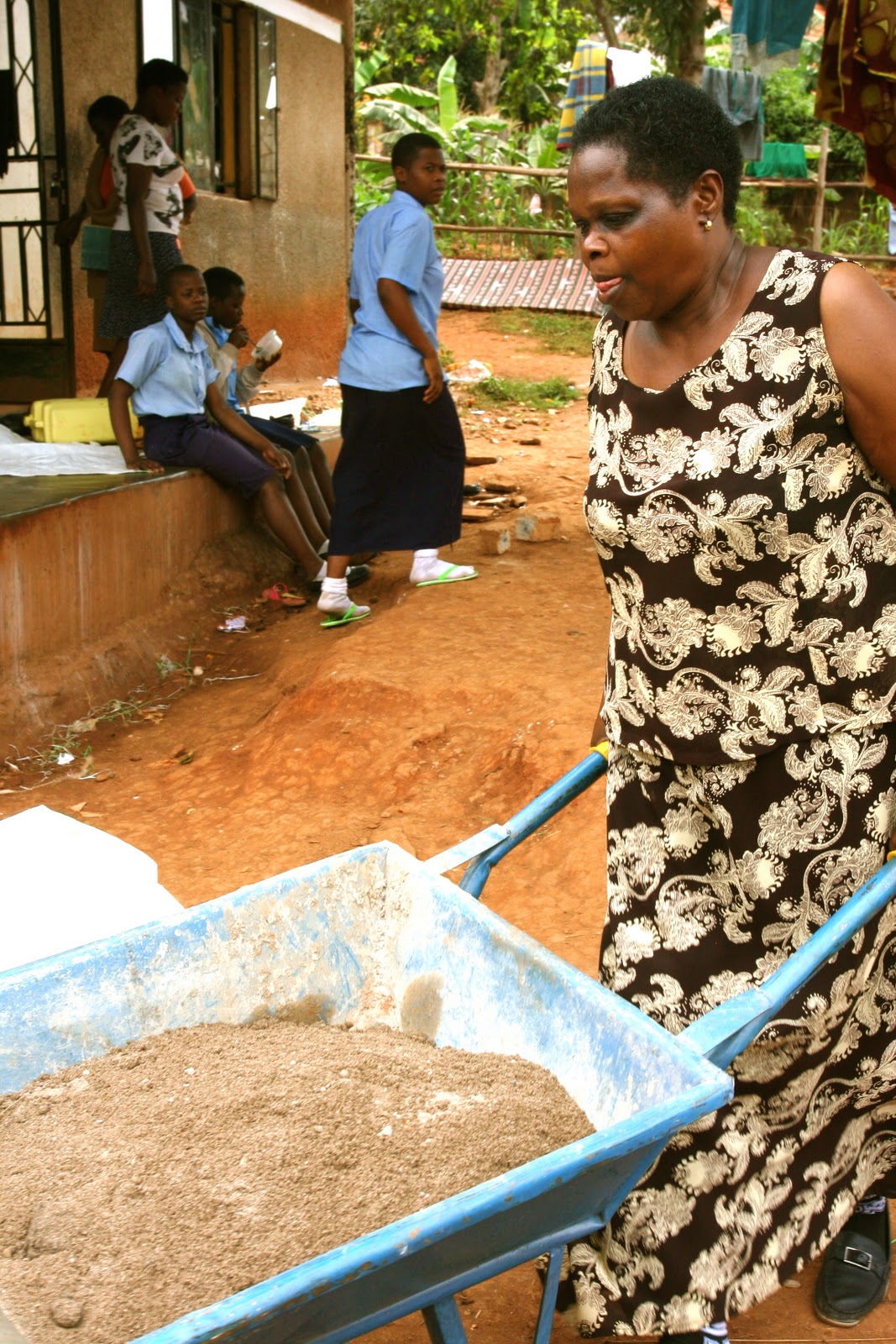
Rosemary and Jacqueline building a Ferro Cement Tank during the 2011 East Africa Women and Water Training in Uganda
When Rosemary and Joy met Jackie and Dorothy, it wasn’t in Kisumu where they all live and work--- It was  in Uganda at the 2011 East Africa Women and Water Training coordinated by Global Women’s Water Initiave (GWWI). Joy and Rosemary were selected because of their work with Kisumu Medical and Education Trust (KMET), an organization that promotes development of under-served communities through innovative health and education programs. KMET was connected to GWWI through American Jewish World Service (AJWS). KMET did not have a WASH (water, sanitation and hygiene) program as part of their health initiative, but they discovered through surveys that their communities’ identified ‘access to clean water’ as a priority need.  And thus the collaboration between GWWI and KMET began.

Jackie and Dorothy are two professionals who are part of a volunteer youth group and had the vision to provide clean water technologies in their home villages. At the training Jackie was also representing the Kisumu based organization Lake Victoria South Water Services Board, and she had the goal to learn how to build and manage a rainwater harvesting system using a new tank technology so that she could feel confident bringing the technology to LVSWSB to replicate.

Both teams learned how to build the interlocking stabilized soil bricks (ISSB) tank for rain water harvesting. The bricks are made out of marram (clay), sand, a little cement and water, and they are shaped such that they can lock together which makes them much more stable.Using the ISSB supports the intention to use local resources that are also economically attainable, as ISSB technology requires considerably less cement to make. The ISSB tanks are nearly half the price to build a ferro-cement or plastic tank  which are the most common technologies implemented around the region. Furthermore, the special machine used to compress the bricks is a simple technology that could be easily learned and used by anyone.

Before the Kisumu teams left the training in Uganda, they had already begun collaborating, and knew that having the interlocking machine was key to introducing and building the rain water harvesting tanks. When KMET implemented its technology, Dorothy and Jackie came by the site frequently to support, further helping them them to solidify what they had previously learned at the training. This also means that in the following week when Dorothy and Jackie implemented, they had a much easier time constructing their tank thanks to the learnings from Joyce and Rosemary. Both teams have plans to possibly purchase an interlocking machine together (about $1300US) so they can share it  and use it to make and sell bricks for income-generation.


We envision  many more of such collaborations and partnerships to emerge as we undertake subsequent trainings uniting women for a thriving planet. We know that these trainings are the first point of contact for such powerful networking  and connections to be created, and we want to build on these opportunities to maintain connections and linkages that emerge. This, combined with the vision of engaging to build a strong movement of women championing environmental causes, makes  a compelling case for staying aligned and connected. We hope that the East Africa Network for Women and the Environment that WEA’s Africa Program is debuting, will be the platform for this vision to materialize and for many more partnerships and collaborations to blossom.

Monday, December 12, 2011

Planting Seeds of Resilience


Last week, we celebrated the Women's Earth Alliance India Program at our special event--Seeds of Resilience: Women Farmers Striving in the Face of Climate Change

Be sure to check out photos from the event here and watch the new India video

We are touched by the outpouring of support from our community, and were glad to share personal stories of how women farmers hold the key to promoting food security in India. A special thank you to our Promotional Partners, and those who tabled at the Local Solutions Salon, including AWID, Balance Edutainment/Pacha's Pajamas, Bay Localize, DIG Cooperative, Earth Island Institute, Ecology Center, Global Exchange, Global Fund for Women, Harmony Festival, IDEX, Food First/Institute for Food and Development Policy, Planting Justice, Richmond Grows Seed Lending Library, The Living Seed Company and Urban Adamah. A warm thank you to Todd Boston and Aharon for offering their musical gifts and performing live at the event.

We are proud to stand in solidarity with the efforts of our incredible grassroots partner, Gorakhpur Environmental Action Group, and to support the bold visions of rural women, who are the rising new leaders in their communities and are leading others by example by farming organically, by stewarding their natural resources and building the capacities of other women farmers to do the same.

We are also grateful to be graced by the wise words of Joanna Macy. She, too, affirmed that the women farmers in the India Training, like Ram Ratti and Manju Devi, are leaders in growing food sustainably - a crucial role given how the modern world's food system is impacting our environment and climate. 

Thank you for planting seeds of resilience in our hearts by supporting the India Program. We look forward to deepening our work in India in 2012 and beyond. 


Monday, December 5, 2011

WEA Advocacy Training: Building Bridges for Dialogue and Collaboration


This November 4th – 6th, WEA hosted our first Advocacy Training, in partnership with Indigenous Environmental Network. We’re proud to share that the Training was a success.
Our Training took place at the David Brower Center in Berkeley, CA, which is located on Ohlone territory. Muwekma Ohlone elder Ann Marie Sayers opened the Training on Friday morning with a welcome and blessing.

Over the course of these three packed days, participants formed new partnerships, shared intensive dialogue, and learned key tools and strategies for advancing environmental justice with Indigenous peoples. The Training also yielded several mandates for WEA’s integral forward motion, as we continue deepening our relationships and our legal and policy advocacy work for environmental justice in collaboration with grassroots Indigenous women leaders.

The Training engaged approximately 35 advocates as new members of the WEA Advocacy Network – a great boon to the stability and longevity of our work. Participants were almost entirely advocates who were not previously involved in the Advocacy Network. Our participants came from all over the United States, representing some of the following organizations: Center for Biological Diversity; Earthjustice; International Accountability Project; NAACP; Three Degrees Project; University of Denver Environmental Law Clinic; and many more.

I just wanted to extend some gratitude for having the opportunity to take part in such an enriching and wonderful event. I left the training forever changed. I look forward to being part of the vibrant and wonderful advocacy network and also continuing to take part in the other elements of WEA.
- Kimaada LeGendre, Vermont Law School, advocate/ participant

We were honored by participation and presentations from representatives from 18 Indigenous-led groups, and 7 non-Indigenous groups with a history of strong alliances with Indigenous peoples. Presenters and facilitators provided critical, foundational knowledge to participants on the process of building successful alliances, tools and strategies for success, and current needs for legal and policy advocacy support.

As a Native person, a practitioner, and an attorney, I found it very inspiring and helpful to strategize in a way that’s real and that’s culturally grounded – this is something very rare, and has given me a lot of hope for the work that I do.
- Kapua Sproat (Kanaka Maoli), Ka Huli Ao Center for Excellence in Native Hawaiian Law, presenter

Many of the Indigenous groups represented at the Training, as well as several others, shared requests for advocacy collaboration through our docket. Already, first-level discussions have been initiated towards 11 collaborations between grassroots Indigenous activists, with the legal and policy advocates who participated. Please stay tuned for more details about the specific advocacy initiatives that arise from the Training, and the next steps for WEA’s North America program.

Thanks to WEA's organizational partner, Indigenous Environmental Network; Steering Committee members - including Jihan Gearon (Dine') of Black Mesa Water Coalition, Debra Harry (Kooyooe Dukaddo) of Indigenous Peoples' Council on Biocolonialism, Winona LaDuke (Anishinaabe) of Honor the Earth, Toby McLeod of Sacred Land Film Project, Tia Oros Peters (Zuni) of Seventh Generation Fund, Carolyn Raffensperger of Science and Environmental Health Network; our lead facilitator Roberto Vargas, all the WEA staff and volunteers who produced the Training, all those who contributed financial resources towards the Training, and most of all, everyone who attended and gave so much of themselves towards the success of our first Advocacy Training.

Friday, December 2, 2011

Making Ripples: Zero to 2800 in Four Months


Exciting news rippling out from East Africa! It has been four months since the Global Women’s Water Initiative completed Phase One of our third African Women and Water Training Program in Kampala, Uganda (Read more about the Phase 1). Fifty two women from East Africa and the United States came to Kampala to attend the GWWI Training to learn educational and technological solutions to address their communities’ water and sanitation needs. Most were strangers when they arrived, but by the time they left Kampala, partnerships were formed which has rippled out into waves of change in communities across East Africa.

Today, over 2800 people have access to clean water and sanitation!
And this is just the beginning.

How did they do this? Immediately after the Kampala Training in Phase 2 of the program, GWWI Grassroots Teams were given an opportunity to apply for a $1500 seed grant to implement what they learned. 15 teams received their grants, mobilized their communities, and with support from the GWWI coordinating team (trainers, fellows, and trainers-in-training), built nine rainwater harvesting systems with storage tanks, and introduced four Biosand Filter and three Ventilated Improved Pit Latrine projects in slum and rural communities in Uganda, Tanzania and Kenya.

What did we learn from the past?
 This GWWI created a WASH Peer Support Network by incorporating East African and International Fellows as well as GWWI graduates (Trainer’s in Training or TT) to partner with the Grassroots Teams to help them reach their goals. The Support Network act as global peers offering assistance in coordinating, co-training and  problem-solving during every step of the planning and implementation process. In our past GWWI trainings in Kenya (2008) and Ghana (2010), it took up to a year or more for the Grassroots Teams to implement their first technology. This cycle took less than four months. Not only have we seen greater impact, but faster implementation as well much in part because of this network.

What’s next?
As we transition into Phase 3, the participants must mobilize their own resources to replicate technologies learned during the training to expand their WASH programs to meet the GWWI criteria for two technology implementations within a year. This means engaging local leaders and community members for long term support, acquiring building materials, planning all logistics of construction and outreach and designing a larger scale program to have a greater reach.  Two teams have already implemented their second technology for Phase 3 and we expect two additional Teams to do so by the end of the year!

The East Africa Network for Women and the Environment!
Drawing and building on the significant contributions by a strong peer support  network of international and East African fellows as well as GWWI graduates/Trainers-in-Training, Women’s Earth Alliance’s Africa program is responding with the creation of an East Africa Network for Women and the Environment (EANWE). The creation of such a network to link and connect women at the helm of environmental and climate justice issues is long overdue, and the Africa program is excited to be in the initial stages of forming the East Africa Network for Women and the Environment. This Network aims to create linkages and networking opportunities for the partners of the Africa Program and will connect environmental activists, women’s right advocates, development practitioners, non-profit and community based organizations (CBO) working at the nexus of women and the environment. Through EANWE, members connect, share knowledge and build coalitions to address emerging issues facing women and the environment in East Africa. Networking remains a critical tool for women and girls to break the cycle of dependency and to engage in development at all levels and it also allows for highlighting and amplifying women’s contributions and voices in seeking solutions to the environmental and climate issues of our time.

Wednesday, November 23, 2011

Give a Sh*t


If you didn’t know, Nov 19 was World Toilet Day. Why, you ask, would we dedicate a day recognized around the world - to a toilet? Because one out of three people on the planet do not have access to one. The lack of safe disposal and treatment of human waste is one of the major causes of biological contamination in water, which spreads diseases like cholera, dysentery, giardia etc. One of the main symptoms of water related disease is diarrhea, which can also lead to malnutrition--the highest cause of death in the world. What does that mean? There is sh*t in the water and people are getting sick from drinking and using dirty water. 

But for girls, that isn’t the half of it. Having a toilet could determine a girls future. If there are no toilets in schools, then girls who have started their menstrual cycle can miss school at least one week per month and sometimes drop out entirely.

Global Women’s Water Initiative is dedicated to supporting women and girls to learn the importance of clean water, sanitation and hygiene (WASH) and how they are all intricately linked. If we have clean water and toilets, but don’t wash our hands, we can get sick. If we have a water source and people sh*t anywhere, water can get contaminated especially during rainy season. If we wash our hands, but use dirty water and no soap, we are at high risk of disease. You get the picture. Effective water, sanitation AND hygiene practices must be addressed together and in an integrated way.

GWWI provides the tools for women to address these issues deeply and holistically. Women who attend our trainings are able to test water for contamination, share effective WASH practices to improve hygiene practices, offer strategies to protect water sources, treat contaminated water and build appropriate technologies that can reduce the risk of water-related disease.

Can you imagine what kinds of opportunities can arise for women and girls by just having a toilet? GWWI does. Won’t you give a sh*t and join us?

Friday, November 18, 2011

Matilda is why WEA believes...

Matilda (far right) with women from the Mukono Women's AIDS Task Force (MWATF) in Mukono, Uganda in 2011

Three years ago Matilda Nabukonde had never picked up a shovel. Today, she can build rainwater harvesting systems (RWH), biosand water filters (BSF) and ventilated improved pit (VIP) latrines. She offers hygiene education workshops to hundreds of people in remote rural areas in Uganda and slums of Kampala. A grandmother and caretaker, Matilda is a powerful force in the communities she serves. 

We first met Matilda when she was selected to attend the Global Women’s Water Initiative (GWWI) 2008 Women and Water Training in Nairobi, Kenya. A representative of a local organization called Uganda Community Based Association for Children’s Welfare (UCOBAC), Matilda joined us in Kenya because she wanted to launch a clean water initiative for her community. Despite having malaria, Matilda participated in all workshops; she learned to build a ferro-cement tank, harvest water off thatched roofs and collect rainwater by building a simple “purpose built” system—an affordable catchment using four posts and a small sheet of corrugated iron sheets to create a free-standing sloping surface.

After the training Matilda, along with the other 14 participant teams, received a seed grant from GWWI to construct a water and sanitation project in her community. Realizing the high cost of constructing one ferro-cement tank, Matilda and her partner invested in several small purpose-built systems that were more cost-effective and appropriate for their community. Together, they built multiple systems and trained grandmothers and orphans how to do the same. When the money ran out, Matilda raised additional funds to train and build more systems.

Matilda’s story as a WASH implementer didn't stop at the 2008 training.

In 2010, Matilda was interested in expanding the budding Water and Sanitation Hygiene (WASH) program at her organization UCOBAC.  So, she attended a Biosand Water Filter training conducted by Global Women’s Water Initiative (GWWI) partner organization, A Single Drop. At the workshop, Matilda deepened her knowledge on water treatment processes to improve water quality in areas where water is abundant but not safe to drink.

Following the training, Matilda built and installed filters at UCOBAC’s newly opened health clinic serving slum dwellers in Kampala. She is currently designing a micro-business plan to expand her safe water project. Meanwhile, she also designed a more comprehensive WASH educational outreach campaign utilizing the Portable Microbiology Lab to test water for fecal contamination. She uses the results of the tests to educate the communities on the impacts of poor sanitation to convince communities that better hygiene practices, and source protection techniques are important first steps to better health. 

In 2011, we responded to the needs of graduates with great promising leadership like Matilda. Along with other past Women and Water Training graduates, Matilda was invited to participate in an Advanced Training Program designed to support women like Matilda who wanted to professionalize their water and sanitation skills to become full-service WASH Trainers. As a Trainer-in Training, Matilda mentored the new Grassroots Teams, supporting them as they designed their WASH projects. She also added an additional technology—the Ventilated Improved Pit Latrine (VIP)—to her WASH toolbox. Within weeks of the training, Matilda and her team returned to the Chamanga slum and mobilized a community to build a new latrine. 

Matilda gives us hope that women leaders can transform their own communities.  Matilda is now equipped with multiple solutions to improve health in her community and surrounding ones.  Her services are in demand in a sector where men have been traditionally sought. She sets a strong example for other women who have the opportunity to recognize that not only do they hold the solutions, they can build them.

We are inspired by Matilda and stand in solidarity with our Ugandan sister as she restores balance to the earth.

Support our work in uplifting the leadership of women like Matilda. The ripple effect is real.


Wednesday, November 16, 2011

Live from the 3rd Phase of the Women, Food Security and Climate Change Training

Women Farmer and Participant of the 2011 Women, Food Security and Climate Change Training in Uttar Pradesh, India
The following is a report from India Program Director, Rucha Chitnis, who is in Uttar Pradesh, India for the final phase of the India Women, Food Security and Climate Change Training. 
 
Climate change and food security continue to emerge as key global issues. In particular, they pose as persistent and disproportionate challenges for women. This year, WEA partnered with Indian organization, Gorakhpur Environmental Action Group (GEAG) to design the ground-breaking Women, Food Security and Climate Change Training in Northern India.  The 3 phase training supports women farmers to respond to climate change with resilience so that they can ensure the food security and well-being of their families and communities. There have been two previous phases of this training--one in April 2011, the other in September 2011--where  Indian women farmers gathered to gain hands-on skills in ecological farming techniques, develop peer networks, learn ways to mitigate the impacts of climate change, develop year-long action plans, and receive seed grants to launch community projects. 

During this final phase of the Training, participants strategized on advocacy and movement-building strategies to demand the recognition of women as farmers and India's key food producers, and to assert their rights to land and other resources (including government extension services that are rarely available for women farmers).

This Training is now in its final phase in Uttar Pradesh, reuniting 30 women farmers to share their learnings from the past 6 months of action plan implementation in their communities. Many of their action plans sought to improve the food security of small and marginal women farmers in the face of devastating floods. 

Reena a participant from Bihar, shared how she facilitated the planting of 6,000 trees in 15 villages through her network of women's groups and set up 4 farmer clubs of women, who were trained on organic farming practices.  Manju, a trainer from Bihar, created 11 farmer committees of 144 women, and coordinated trainings for women on seed saving, mixed farming, bio-pesticides, and organic kitchen gardens. Want to read more?

Two of the participants of the 2011 Women, Food Security and Climate Change Training in Uttar Pradesh, India


"One tree equals the birth of a 100 sons."
Reena, a participant at the Women, Food Security and Climate Change Training


Thursday, October 27, 2011

November 4: Steadying the Seasons


Photo by: Phillippe Ponchaux

Women's Earth Alliance is preparing to host our first Advocacy Training, November 4th – 6th, 2011, here at the David Brower Center in Berkeley.  With guidance from our Steering Committee and organizational partner, Indigenous Environmental Network, we're convening 75 advocates and activists for three days of dialogue, learning and collaborative action towards environmental justice for Indigenous peoples.  The training will prepare advocates - from large law firms, national NGOs, and major universities – to use tested and emerging advocacy tools; build capacity for effective cross–cultural partnerships; and generate strategies for action on health and environmental justice.

We're thrilled that this long-anticipated event is coming to fruition!  Please stay tuned for updates leading up to, and after, the Training, about the impacts of our work and the new initiatives emerging from this convening.  We honor the talented and dedicated advocates who are joining us to learn and participate.  As Tom Goldtooth, Executive Director of Indigenous Environmental Network, commends our participants: "thank you for standing strong in defense of the sacredness of Mother Earth and for our future generations." 

How can you be a part of our work with Indigenous peoples towards the protection of health, culture and sacred land?

On Friday, November 4th, join us for Steadying the Seasons: Indigenous Peoples on the Front Lines of Climate Change in North America.   This dynamic evening will include storytelling from three leading Indigenous climate justice activists, as well as a short film about the Athabascan tar sands and their impacts on Indigenous peoples and the climate.

Please see our website for more information and to buy tickets.  The evening begins with a reception at 6:30 PM; please arrive by 7:15 for the program.  2150 Allston Way in Berkeley.

See you there!

Tuesday, October 25, 2011

WEA at Bioneers: Leadership at the Nexus

Last week, the WEA Team was thrilled to co-facilitate the 2011 Bioneers Post-Conference Intensive, Leadership at the Nexus: When Women Thrive, Communities Thrive. Along with Nina Simons, Co-Founder and CEO of Bioneers, WEA’s Directors and a dynamic group of multi-generational women leaders participated in a daylong session of personal vision cultivation, collective learning, and collaboration.
Drawing upon their own experiences as well as the wisdom of WEA’s grassroots partners, the WEA Directors created a day full of effective and creative strategizing. Powerful exercises, personal story telling and intimate networking allowed this gathering of women to cultivate their own personal leadership. Participants created dynamic and unique visions, partook in SWOT (Strengths, Weakness Opportunities and Threats) analyses, and explored the boundaries – and the solutions to those boundaries – keeping them from accomplishing their goals in small groups. There is no doubt - When women leaders collaborate the world changes. This special space of exploration, self-critiquing and collaboration resulted in a 3-step action plan for the next month, as well as an assignment of accountability partners to support the women on their journey of leadership.

Many thanks to Nina Simons and to the conference’s participants – we are honored to work with you in the cultivation of your personal leadership, and look forward to hearing about all of your future successes. You are whole women and whole leaders for a whole world!

Tuesday, October 11, 2011

The Weight of Water

Photo Credit: Kate Clayton-Jones
"I came into this world carrying water on my head, and I refuse to leave this world still carrying it." ~Mildred Mkandla from an interview with WEA Research Fellow, Beth Robertson, during the 2011 GWWI Women and Water Training in Uganda.

Mildred Mkandla, known as “Mama Maji” (Mama Water in Swahili) is the “MacGyver” of rainwater harvesting. She believes that every drop of water is precious and can be harnessed, captured and stored using almost anything. Give her some rocks and she’ll make a water catchment system. Give her a plastic tarp and she’ll capture rainwater off a thatched roof. Give her a piece of bamboo and she’ll make a gutter. Because rural grassroots communities may not have access to financial capital, appropriate roofs to hang gutters, or even the materials necessary to build tanks, Mama Maji works with African women to provide access to different water harvesting options that are financially feasible and contextually appropriate.  As the Rainwater Harvesting Trainer at both the 2008 and 2011 GWWI Women and Water Trainings, Mama Maji helped to construct various rain catchment systems for our participants to learn, including an 11,000 liter Ferro-cement tank. 


Mildred first came to the Global Women’s Water Initiative in 2008 from Ethiopia where she was the External Relations Director of EarthCare Africa Policy Monitoring Institute. At the time she was a development activist with more than 35 years experience in the fields of health, education and environment focusing mainly on women and children. She shifted her focus to water, gender and health in 2000. Now a seasoned RWH trainer, Mama Maji has offered trainings all over Africa. Her biggest achievement in this respect was a project on Empowering Women through Rainwater Harvesting in Kenya. This project concentrated in Kajiado District amongst the Masaai Pastoralists where women compete with livestock for water access. 


Mildred has since moved back to her homeland of Zimbabwe where she believes that everything must start at home. She lives on her organic farm with her family and practices what she preaches. She has a 46,000 liter tank, that she built, which provides enough water for her family and the workers who live there. She is reconnecting with her community to share the knowledge she has gained from her work around the continent.

 Mildred believes that teaching communities to create their own water source by capturing and storing rainwater is just one step in relieving women and girls from the burden of accessing water. The rest lies in the trainee’s commitment to enroll others in their vision.

"After building this tank in my community I have heard of others who want them too ... I see a seasonal build -- this season we build for one person, the next season we build for another person. We build and build until the whole community is covered with tanks and no one has to walk for water...."-Grace Kyoma, 2011 GWWI Training participant from Kiotjo Integrated Development Association (KIDA), Uganda after she installed her first Rainwater Harvesting Tank in her community

Even with her contributions, Mildred believes that there is much work to be done. At the 2011 Training in Uganda, she encouraged the participants to sign the Buziga Declaration, stating:

“We 56 women from Sub-Saharan Africa and the United States attending the East Africa Women and Water Training at Buziga Country Resort, Kampala, Uganda from 4th to 17th July 2011; having reaffirmed the integral role of women in water security, sanitation and hygiene-WASH, Do here by commit ourselves to working towards a world water movement that is committed to ensuring that every woman has adequate access to safe water and sanitation by 2025.
Signed this 18th day of July 2011
Kampala, Uganda”

The signatories hope that the Buziga Declaration will raise multi-level awareness to ensure access to safe water and by so doing lift the weight of water off of women and girls.

We stand in solidarity with Mildred and are inspired by her efforts to do her part. Together we are doing the best that we can, like the story of the hummingbird as told by the late Wangari Maathai. Click the following links to see Mama Maji in action at the 2008 Women and Water Training and the 2011 East African Women and Water Trainings.