Wednesday, May 16, 2012

GWWI Women and Water on Wednesdays: Solar CooKit - Using the Sun to Clean Water


One of the cheapest and greenest ways to clean water is to harness the heat of the sun! As Mama Solar, GWWI Solar CooKit Trainer says, 'the sun is free and we here in Africa have plenty of it!'   The sun's heat is used to pasteurize water which has the same effects as boiling, but is much cheaper and is less damaging to the environment. Boiling is one of the easiest and most widely practiced water treatments promoted around the globe, but is prohibitive in developing countries for several reasons. 1) fuel or coal is costly for families making less than a $1 a day 2) wood collection contributes to deforestation 3) burning fuel, coal or wood creates air pollution.

Carrying Wood

The process of boiling requires the water to heat to 100 Celsius. Once it reaches this high temperature, it kills disease-causing germs. Pasteurization, however, requires the water only to be heated to 60 Celsius, but at a longer sustained heat. This can be achieved by putting contaminated clear water in a covered black pot (which can be painted with simple chalkboard paint) to attract heat, enclosed in a large clear plastic bag to contain the heat, and placed inside a Solar CooKit to intensify the heat.
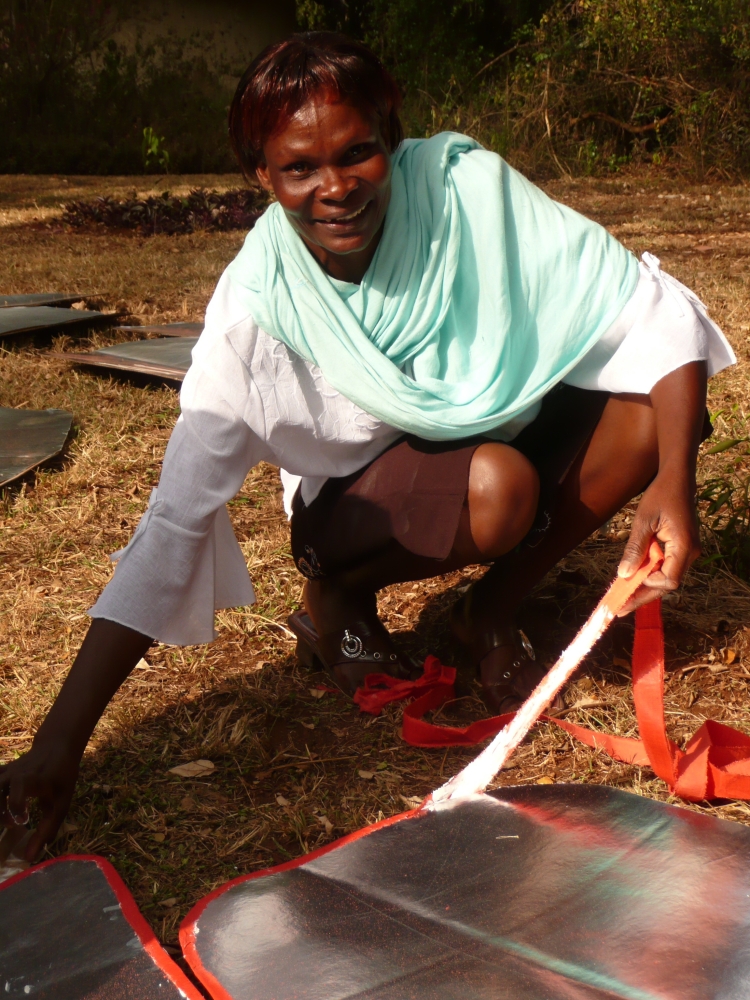
Solar CooKit with bag

The Global Women's Water Initiative introduces the Solar CooKit as one of the core technologies women learn at our Women and Water Trainings. On Day 1, women make their own Solar CooKit! Made simply with recycled cardboard boxes, reflective material (aluminum foil, the inside of juice boxes etc), cloth for lining and reinforcing the edges, and glue. In just a few short hours the women have their first technology completed and ready to use!

The finished Solar CooKits!

During the rest of the Training week, they set the CooKits up in the morning if it's a sunny day to clean their water, share recipes and cook delicious food. They leave them to sit in the sun while they spend the rest of the day in training sessions and building other technologies. When they return after a few to several hours (depending on the strength of the sun that day) their water is clean and their food is cooked!  

Food made with the CooKits

There are so many reasons to love the Solar CooKits. All the materials to make the CooKit are available locally.  Women have less dependence on coal and fuel and reduction in deforestation. Once they have the technology, cooking is free – on sunny days of course! And most important, women are freed up to do other things while they are cooking and cleaning their water. WIN for the women, WIN for the environment, WIN for family health!

You can make one too! Download the instructions and recipes here from the Solar Cookers International website. 
Like Global Women's Water on Facebook
Follow GWWI on Twitter
Follow Gemma, GWWI Director and HuffPost Blogger on Twitter

Thursday, May 10, 2012

Land is Life

By Nancy Djembe | Intern, Sub-Saharan Africa Program | Women's Earth Alliance


Last Thursday, May 3rd, I came home so angry and frustrated about what I had just learned from Anuradha Mittal's lecture on land grabs in Africa. Anuradha is the founder and director of the Oakland Institute, a think-tank that works to "increase public participation and promote fair debate on critical social, economic and environmental issues in both national and international forums."


I was angry because thousands of Africans are being displaced as western corporations and institutions continue to benefit from unfair land deals. For example, AgroSol, a US based corporation has access to thousands of hectares of land in Tanzania at the expense of local communities for whom land is a source of livelihood. My anger also stems from the fact that African governments fail to uphold the interests of its own people, especially women, who are disproportionately impacted by these land-grabs.

In Sub-Saharan Africa, women make up 70% of smallholder farmers, producing about 80% of food. The direct connection of women to land as natural resource managers undermines their ability to sustain their livelihoods. 


Land-grabs in Africa is a not a new issue. There are several parallels between the land grabs happening today and the scramble and partition of Africa in the 19th century. What is more disturbing is that these land-grabs are being framed as bringing economic growth to the continent, while in reality, land grabs are displacing people, destroying livelihoods and communities, undermining local economies and self-reliance, and fueling foreign dependency. 


Several organizations in Africa and abroad, such as Third World Network (Ghana) and the Oakland Institute, Priority Africa Network are engaged in research and advocacy initiatives to raise awareness on this alarming trend. To effectively address land-grabs, it will require a critical mass of voices to speak out; good governance with accountability and transparency; visionary leadership; advocacy and education. As Anuradha Mittal shared in her lecture, "land is life, and not a luxury or a choice." As such, it is critical to ensure that all people can have access to and enjoy their rights to land. 


Wednesday, May 9, 2012

GWWI Women and Water on Wednesdays: Congratulations to GWWI Trainer Godliver Businge Graduating #1 in Her Class!

Godliver lays foundation for the toilet slab

A huge congratulations goes out to Global Women's Water Initiative (GWWI) Trainer Godliver Businge who recently graduated #1 in her class at St Joseph's Technical Institute in Uganda – and incidentally, the ONLY WOMAN! Not only did Godliver receive top marks in Civil Engineering, on April 28, 2012, she gave the commencement speech attended by the Minister of Education, who soon after invited her to his office and offered her a job. She graciously declined because she has her sights on getting her degree and ultimately her PhD in Civil Engineering. 

Godliver the Engineer
We met Godliver when she was attending the Uganda Rural Development and Training Programme where she was working towards a Certificate in Bricklaying and Concrete Practice. URDT trains people who live on less than $1 per day to take a visionary, entrepreneurial approach to developing their own lives, families and communities.  We hired her to train GWWI participants to build Ventilated Improved Pit (VIP) toilets to meet the sanitation needs of their communities. Decked from head to toe in her construction coveralls and protective helmet, Godliver was an inspiration to the GWWI participants, as well as the students at the school where the VIP was built during our Women and Water Training in Kampala, Uganda in July 2011. The participants were very impressed by her meticulous and detailed instruction and her capacity to simplify the construction since many of the women had never picked up a shovel in their lives. One female student at the school declared "When I grow up, I want to be an engineer"!

Godliver's mission is to engage more Ugandan women to pursue engineering and become professionals. She had a local radio show called "Ladies Night" and went into the villages to recruit more girls. Through her efforts, URDT saw a three-fold increase in enrollment to the URDT Girls School.  

After graduation, Godliver was contracted to help design and construct  small scale hydro-electric schemes in Kasese and Fort Portal. They are working towards manufacturing the turbine locally to ensure that it can be maintained and repaired by local community members.
Godliver at her Graduation
At the young age of 25, Godliver is a role model for all of us. A true Water Champion, Godliver is determined to pave the way for women to challenge gender stereotypes, professionalize their services and take the lead in an issue that affects them deeply – water and sanitation.


Like Global Women’s Water on Facebook

Tuesday, May 8, 2012

Climate Change Resilience Begins With Women

Blog post by Rucha Chitnis, WEA's South Asia Program Director
Twitter: @ruchachitnis

Women farmers, like Manju, play a crucial role in building the resilience
of their communities in the face of climate change

Manju Devi is a farmer, a single mother of three and a dedicated field worker with a local grassroots organization called Nav Jagriti in Bihar, one of the poorest states in India. Manju is on a mission to build the self-reliance of women in her community who are affected by poverty, food insecurity and climate change. Women farmers in her community are particularly affected by floods and prolonged waterlogging issues.

Manju was one of the participants of the Women, Food Security and Climate Change Training program that was designed and coordinated by Women’s Earth Alliance’s partner, Gorakhpur Environmental Action Group (GEAG), a grassroots organization working with small and landless women farmers through a people-centered approach focusing on their participation and empowerment for sustainable development. GEAG's efforts also target poverty and hunger reduction by connecting women farmers with sustainable agricultural training, advocacy and networking support.

The goal of this training was to facilitate a regional exchange between women farmers and rural NGO workers from four flood-affected states to share their personal experiences with climate change and its impact on their health, livelihoods and food security. The training equipped women with information about sustainable agricultural practices, such as mixed farming--growing diverse food crops on small farms and making natural pesticides and fertilizers using farm inputs.  Participants also learned about local and regional campaigns to advance women’s rights as farmers. Manju was particularly inspired meeting women from a community in Sahranpur, who were successful in winning back their forest rights access from a corrupt contractor who had exploited them for years. The women shared with, much pride, how they finally won their rights through a long sustained joint solidarity struggle.

Manju set up an organic kitchen garden as a
demonstration site for other women farmers

Manju was clearly inspired and invigorated by the training, and she returned to her community with a plan to make a difference. First, she set up her own organic kitchen garden as a demonstration site to show women farmers how they could grow a variety of vegetables right at home even if their farms were flooded. She went on to organize 11 women’s groups, training 144 farmers on seed-saving practices and growing a variety of vegetables and grains using mixed farming techniques. Finally, she educated women on their rights as farmers and shared information on beneficial government programs that women could access to improve their economic and food security. 

"My vision is that women in my community stand on their own feet and embrace organic farming practices.  I am leading by example to show how this can be achieved," she proudly beamed. Women farmers, like Manju, clearly demonstrate how they play a crucial role in building the leadership capacities of other vulnerable women in their communities who are acutely affected by climate challenges, such as floods and droughts.  As cultural and natural resource stewards of their communities, they are positioned to make a difference by using their traditional ecological knowledge systems of farming, seed saving of robust indigenous crops like millets, which require little to no water for irrigation, and by engaging actively in the political and civic affairs of their communities.

Farmers like Manju recognize that one sure way of increasing the resilience of rural communities in the face of climate change is to end the inequalities and discrimination that rural women face so that they can access critical information, useful agriculture extension training services and increase their participation in disaster management programs.  


This farmer started her own organic kitchen
garden after being trained by Manju


Another woman farmer has a steady supply of vegetables
after starting an organic kitchen garden at home

Thursday, May 3, 2012

Transforming Economic Power, Transforming Ourselves


Blog entry by Rucha Chitnis, India Director of Women’s Earth Alliance
Twitter: @ruchachitnis

I had the honor of attending the 12th AWID Forum held in Istanbul last month. This was an astonishing convergence of nearly 2,500 grassroots activists, scholars, feminist economists, donors, artists and writers. We gathered to learn and share how global economic forces are impacting women’s human rights and our planet.  The Forum--Transforming Economic Power to Advance Women’s Rights and Justice was a gathering to reimagine and reshape an unequal global economic paradigm that has further marginalized those who are already acutely affected by injustices and poverty -- women of color, indigenous women and those impacted by militarism.

It is impossible to summarize the sophisticated level of analysis or share the diversity and vitality of the myriad plenaries, breakout sessions, evening events and solidarity roundtables that went unabated for four days. But here are a few personal learnings, takeaways and “Aha” moments that I wanted to share with you.

  • "Another US is necessary for another world to be possible": Maria Poblet, Executive Director of Causa Justa-Just Cause, poetically emphasized that those of us who live in the “belly of the beast” have a responsibility to build solidarity and joint struggle with international movements.  Maria also underscored the need to expand and deepen the political vision of the Occupy movement, which is “largely white men” to include minorities and people of color to build a grassroots, multi-racial and generational movement that asserts a shared agenda for economic justice.
  • "The comfort zone is the zone of prejudice": Boaventura de Sousa Santos, internationally renowned scholar and one of the leading organizers of the World Social Forum, shared the need for the convergence of movements and elimination of stereotypes and prejudices. He also called for increased inter-cultural exchanges to share different concepts and ideas of equality. He observed that the feminist movement was best in combining urgency with a call for broader “civilizational change.”
  • Embrace a feminist perspective to Economics: Rebecca Grynspan, working with UNDP Costa Rica, emphasized that we need to promote feminist economics and put issues of equity and equality in the center of the agenda and discourse. It was powerful to hear her emphasize that economic analysis needs to integrate paid and unpaid work of women into the indicators and that an inter-disciplinary approach is crucial to have a more gendered analysis of economics.  Economists also need to begin to take stock of natural ecosystems, the extraction of natural resources and the externalization of costs on the environment and communities by corporations through degradation and pollution. We need to bring women’s economic rights into the larger human rights discourse.
  • Think Eco-systemic not individualistic Approach:  Victoria Tauli-Corpuz, a renowned indigenous activist from the Philippines, shared that the long struggles of indigenous women and the current ecological, economic and cultural crises, are an outcome of a capitalist, patriarchal system that has been reinforced for hundreds of years.  She reminded us that indigenous women are living in some of the last intact ecological areas, a sign that they embrace values of reciprocity, solidarity and live in harmony with Nature.  A reminder that indigenous peoples have their own indicators of well-being beyond mainstream monetary indicators and that cross-cultural exchanges could foster learning from indigenous peoples cultural and spiritual practices. 
FORUM ended with a solidarity march
by participants from around the world
  • Embrace diversity and complexities: Many Forum participants urged the need to embrace the complexities and the diversity of feminist movements. We need to look at the intersections of race, class, age, religion, and sexualities and to engage in more inter-cultural dialogues and exchanges. This should allow us to challenge our own perspectives and have a more thoughtful and unified analysis of the issues facing women.
  • "Disease of “projectitis” affects long-term impact of our work": Joanna Kerr of Action Aid reminded us that there is no magic bullet for development, and this was powerfully highlighted by one of my favorite breakout sessions, Can Monitoring and Evaluation be Feminist?. The panel was moderated by feminist activist and scholar, Srilatha Batliwala. Participants candidly shared their challenges in using complex and stringent monitoring and evaluation (M&E) strategies, which reduced and simplified "change" into quantifiable metrics.  The shared learning from this session was that donors and funders need to create a safe space for evaluations, where women’s groups have a sense of personal ownership to advance their programmatic and strategic goals, rather than experience evaluations like a performance review.
  • Climate change resiliency begins with women: At a session where Women’s Earth Alliance partnered with our sister-organization, IDEX, Luciana Baustista Pedro, an indigenous woman from Mexico, who founded a group called Nepi Behna (Women of Dignity), shared how women are building their resilience in face of environmental and climate challenges by installing rainwater harvesting tanks, using wood-saving stoves and setting up women’s cooperatives through a Fair Trade Artisanship Program. Other Forum sessions also shared examples of how rural women are leading the way for food sovereignty by reviving traditional organic farming and seed saving practices, by asserting their rights as farmers and by playing a key role in large peasant social movements like the Via Campesina. 

Wednesday, May 2, 2012

GWWI Women and Water on Wednesdays: Meet Mama Africa, Anna Anatoli, GWWI 2008 Graduate and 2011 Trainer in Training

GWWI is proud to share this interview of Anna Anatoli, or as she was so aptly named, ‘Mama Africa’.  That’s a big name to live up to, but Anna does a great job filling the bill!  Anna came to the Global Women’s Water Initiative in 2008 to our inaugural Women and Water Training in Kenya. The moment she stepped onto the grounds of the Green Belt Training center in Nairobi, we knew we were in the presence of a powerful leader with deep passion and unwavering persistence.Because of her incredible drive and immense effort to share all the knowledge to her community in Arusha, she was invited to participate in the GWWI Trainers Training program in Uganda in 2011.The development of the GWWI Trainer’s Training Program was inspired by and designed for leaders like Anna to help deepen and expand her knowledge in water, sanitation and hygiene (WASH) solutions.  Anna brought two young women from the Tanzania Girl Guides (the international version of Girl Scouts) to ensure that this knowledge is instilled in the younger generation.


Anna is the founder and Chairperson of ANEPO (Attraction of Natural Environment, we Protect and Organize) from Arusha, Tanzania. Anna works at the forefront of addressing environmental issues as a means to sustain water issues in her community. In a community that faces drought and lack of safe and available drinking water, Anna provides education and training through ANEPO. She trains women on healthy eating and shares all the different techniques and technologies she learned at the GWWI trainings - solar cooking methods, purifying water using the WAPI, (Water Pasteurization Indicator), construction of Biosand Filters and toilets. She also teaches women to harvest rainwater and to use drip methods to grow trees and organic vegetables. She is also the Regional Secretary of the Tanzania Girl Guides Association, an organization that trains girls to become strong women and good citizens.

Africa’s future is in good hands with water champions like Mama Africa taking the lead in building local water and sanitation programs!

Help GWWI meet our goal to have 500 followers by Mother’s Day
Like Global Women's Water Initiative  on FB!
Follow us on Twitter!

Wednesday, April 25, 2012

GWWI Women and Water on Wednesdays: GWWI Director, Gemma Bulos Raising the Voice of Women in Water on Huffington Post!


Gemma Bulos, GWWI Director
The Global Women’s Water Initiative is so excited to announce that Gemma Bulos, GWWI Director,  published a powerful article, “Transforming Women’s Water Burdens Into Economic Opportunities” in the Huffington Post!  Because of this recent piece, she has been invited to be a regular HuffPost blogger!  

As an award-winning social entrepreneur, water advocate, trainer and musician, she now has an international platform to raise the voices of women in water, environment, social entrepreneurship and climate change. This is an incredible opportunity to share the work of GWWI, Women’s Earth Alliance, our partners and peers to bring to the forefront the challenges and most importantly, the solutions that are being implemented all over the globe by one of our most untapped resources – women. 

WE NEED YOUR SUPPORT! To keep the drumbeat going and to ensure that we continue a public conversation about women’s leadership and the environment, we need to build our audience! The more we share this info, the greater the opportunity for us to connect, share and most important  - collaborate!  The Global Women’s Water Initiative has set an ambitious goal of building our FB and Twitter followers to 500 by Mother’s Day! Can you help us?

We invite you to do the following:
  • Read the HuffPost article! (link to in the Huffington Post article http://www.huffingtonpost.com/gemma-bulos/-transforming-womens-wate_b_1439006.htm
  •  Share the article with your friends by clicking “Share”, “Like” and “Tweet” directly from the article
  •  Add a comment to the blog – this will really help to continue the awareness and spark conversation
  • Become a “Fan” of Gemma’s Blogs  (Link to http://www.huffingtonpost.com/gemma-bulos)
  • Like Global Women’s Water Initiative on Facebook to get news, updates, articles and musings from GWWI  Link to https://www.facebook.com/womenwater
  •  Follow us on Twitter @womenwater and @gemmabelle to join a lively conversation about ongoing social entrepreneurship and water work around the globe from our partners and allies
  • Share this with 5 of your friends and invite them to support!
Thank you so much for being part of the conversation! The more we talk about the issues we care about and invite people to take action in whatever way they are feeling most powerful -  the greater chances we have of creating the change we want to see in the world! Join the WAVE!!!

Wednesday, April 18, 2012

GWWI Women and Water on Wednesdays: Angella and Martha Win an Award and Buy a Brick Machine!

Martha

Angella and Martha have two big reasons to celebrate and are one step closer to reaching their goal of providing their community with access to water!  First, they were able to raise funds from their local supporters and community members to buy an ISSB brick-making machine to build strong water tanks and rainwater harvesting systems! At the cost of approximately $1500 which is quite an accomplishment!  And second, they won the Best Booth at the Moyo District Women’s Day Celebration!

Angella
Angella and Martha are from Marindi in Northern Uganda, a region that has been plagued with conflict for decades. Both are retired nurses and have been working tirelessly as facilitators and volunteers to improve community health for the most vulnerable people in their communities – women, orphans and vulnerable children (OVC) and People Living With HIV/AIDS (PLWHA).  Angella and Martha came to the Global Women’s Water Intiative through Patricia Eiyo-Elotu of the UN-World Food Programme. Patricia not only nominated the team, she also led the Climate Change workshop at the GWWI Women and Water Training held in Kamapala last July 2011.

Angella and Martha learned how to build a variety of different rainwater harvesting systems including capturing water from thatched roofs, ferro cement tank construction and how to repair and clean gutters.  On a field trip to Connect Africa, they saw the ISSB tank and new that this technology was the best option for their community situation. The ISSB (interlocking stabilized soil block) machine makes a special kind of brick that is composed simply of marram (earthen clay), sand, a little cement and water.  Because the blocks interlock, the structure is much more stable and requires less cement to bond them together. They went straight home, mobilized their community and built a rainwater harvesting tank for a local school!


Patricia
At Moyo District’s Woman’s Day Celebration they offered a workshop that was attended by the Chairman of the District Council. They made bricks with the ISSB machine, promoted the bricks and offered a demo of the Biosand Filter! Angella and Martha are no stranger to recognition as they have won the Home and Environment Competition for three consecutive years! They have strong relationships with the community and its leaders and because of their transparency, they have developed a deep trust that will ensure that this program will succeed.


Bravo ladies! We are behind you all the way!


Like Global Women's Water Initiative  on FB!
Follow us on Twitter!

Thursday, April 12, 2012

GWWI Women and Water on Wednesdays:  UCOBAC Receives the Gift of Hygiene from CNN Hero, Derek Kayonga!  

The Global Women’s Water Initiative is thrilled to share this video featuring CNN Hero Derek Kayonga of the Global Soap Project (GSP) providing UCOBAC with recycled soap thanks to GWWI Fellow, Lily Dimling!

A primary goal of GWWI is to create an international network of women leaders in the Water, Sanitation and Hygiene (WASH) sector providing a platform for learning and sharing.  When Lily, a leader at Global Soap Project, was selected to participate in the GWWI flagship Fellowship program, one of her main objectives was to learn more about WASH implementation on the ground so GSP could expand their services through WASH education initiatives to supplement their mission to distribute soap. In summer of 2011, the GWWI Fellowship Program mobilized a global team of women graduate students and development professionals to gain a holistic and hands-on training in international development, WASH-related education and appropriate technology.


UCOBAC is one of the two returning organizations that participated in our 2008 and 2010 Women and Water trainings. Led by Solome Mukisa, UCOBAC provides services to improve the welfare of vulnerable children in Uganda through trainings of relevant actors, advocacy and networking using community-based initiatives. GWWI has since sponsored four UCOBAC members to attend GWWI trainings who have learned how to build technologies addressing all three major water challenges – water access (rainwater harvesting techniques), water quality (various water treatments like the Biosand Filter, Solar Cookit ) and sanitation (Ventilated Improved Pit Latrines).  With these skills and technologies, UCOBAC is on their way to becoming a full service Water, Sanitation and Hygiene (WASH) service center.

GWWI knew this would be a perfect opportunity for the Grassroots Teams to be able to partner with an organization like GSP and for Lily to learn nuanced community strategies and witness first hand the challenges grassroots women and communities face. And as it turns out, it was beyond perfect! What an amazing gift for UCOBAC not only to receive soap for their health clinic and other HIV/AIDS orphan programs, but also to have been featured in Derek’s Introduction video for CNN Heroes! Look out for, 2008 graduate and UCOBAC Executive Director, Solome Mukisa at about the 1 minute mark!  Much of the footage is taken in the slum where UCOBAC offers free health services and the site of the UCOBACs first toilet that the community, Lily and others helped build.

Let’s hear it for Water Heros and Sheros bringing hope where it is needed.


Like Global Women's Water Initiative  on FB!
Follow us on Twitter!

Wednesday, April 4, 2012

GWWI Women and Water on Wednesdays: Eye on iCON


When the Global Women’s Water Initiative organizes a training in a region, we identify a strong partner who will be our local host. They are GWWIs most important lens into the intricacies of the regional issues that women face. They also offer their expertise into the appropriate design of the program and ensure that we follow all cultural protocols with respect and reverence. In 2011, GWWI invited iCON Women and Young People’s Leadership Academy ( http://iconwypla.org/) , a Ugandan civil society organization offers transformational leadership trainings to unleash the entrepreneurial leadership potential of women and young people (male and female) who have been socially marginalized to fully take the lead in developing innovative approaches to address poverty, violence, gender inequality and gender inequity in all areas of society.

Debbie Kaddu Serwadda, Executive Director, iCON
GWWI believes that technology implementation is only a piece of the puzzle. Technology solutions will not replicate themselves! Programs work because of people, not because of technology. Developing leadership is a key initiative in GWWIs program design. Debbie Kaddu-Serwadda, iCON Executive Director, spearheaded the leadership sessions at our training, greeting us every morning as “Water Champions”!  Our first course of action was to claim our leadership names!  You can do this too! Take the first letter of your name and find a word that starts with that letter that most exemplifies one of your best leadership qualities! For the rest of the workshop, we called each other by our leadership names to give vibration and voice to each of our sisters to acknowledge that we see them as powerful leaders. We had names like “Daring Dade” and “Inspirational Irene”!  Can you imagine how confident and relevant you feel when other people are seeing and acknowledging you as one of your most powerful qualities?
Ruth records her SWOTs for display
This set the tone for the entire week. Women had arrived feeling a bit intimidated – some feeling a little scared because they had never built anything before, others fearful about speaking in public. Debbie created an incredible safe and powerful space for the women to identify their strengths, weaknesses, opportunities and threats (SWOT) as leaders, a process that brought a profound sense of vulnerability and motivation. Each woman recorded and displayed their own SWOTS on poster paper and hung them all around our conference space.One of the most powerful moments during the training was the “gallery walk” where the women learned each others SWOTs. The women identified other women who had strengths where they themselves felt weak and connected to them for inspiration and support. By the middle of the week women were laying bricks, singing, collaborating, dreaming and standing up in front of their groups boldly declaring their vision for their community!


Elizabeth declaring that one of her strengths is having big ears to listen

As you’ve seen from the blogs, the women are stepping into their leadership with grace and power! Thanks to Debbie and iCON for unleashing our power!


Like us on FB!
Follow us on Twitter!